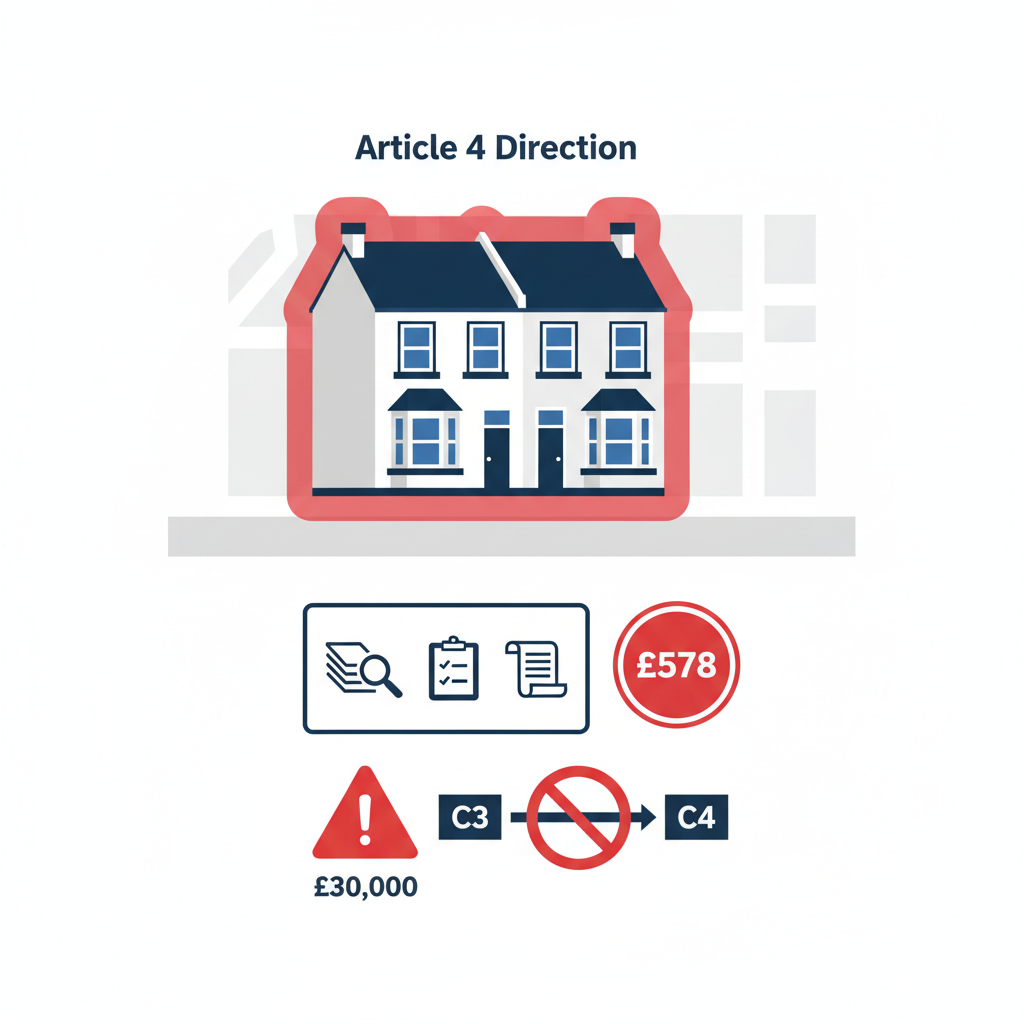
COMPLIANCE ALERT: Operating an unlicensed HMO in an Article 4 area without planning permission can trigger a £30,000 civil penalty per property, enforceable within 28 days of notice.
Article 4 Directions and HMO Permitted Development: What Every Landlord Must Know
The single most critical figure for any landlord operating in a designated area: converting a property to a small HMO (Use Class C4) in an Article 4 direction zone without full planning permission can result in a £30,000 civil penalty, and over 100 local planning authorities across England have now removed permitted development rights for this change of use.
What triggers the loss of permitted development rights for HMOs?
Under standard planning rules in England, converting a dwelling house (Use Class C3) into a small HMO housing between 3 and 6 unrelated occupants (Use Class C4) is permitted development. This means no planning application is ordinarily required. However, under the Town and Country Planning Act 1990, a local planning authority can issue an Article 4 direction, which removes that permitted development right within a defined geographical boundary.
Once an Article 4 direction is confirmed, any landlord wishing to use a property as a C4 HMO in that designated zone must apply for full planning permission before operating. The direction typically takes effect 12 months after it is advertised, though emergency Article 4 directions can take effect immediately. Properties already operating as HMOs before the direction's implementation date are generally considered lawful, provided the landlord can evidence that use predates the direction by at least 4 years under the standard enforcement time limit — though this window moved to 10 years for material change of use under the Levelling-Up and Regeneration Act 2023 for breaches occurring on or after 25 April 2024.
It is equally important to note that Article 4 directions do not affect large HMOs accommodating 7 or more occupants. Those properties sit within Use Class Sui Generis and have always required full planning permission regardless of any Article 4 direction.
What does planning permission cost in an Article 4 area?
If you are caught by an Article 4 direction and need retrospective or prospective planning permission, the standard planning application fee for a change of use in England is £578 per application as of December 2023, following the government's 35% fee increase. Some councils charge additional pre-application advice fees ranging from £150 to £600 depending on the authority and the complexity of the proposal.
Refusal is a genuine risk. Councils that have adopted Article 4 directions typically have accompanying local planning policies restricting further HMO concentrations. Leeds City Council, for example, uses a 10% threshold rule — no more than 10% of dwellings within a 100-metre radius can be HMOs — when assessing planning applications in its Article 4 zones. Oxford City Council has maintained a similar 20% threshold in certain wards since introducing its direction in 2012. A refused application followed by an appeal adds a further wait of approximately 24 to 36 weeks.
How do you apply for HMO planning permission in an Article 4 area?
The application process runs through the council's planning portal. You submit a change of use application from C3 to C4 (or from C3 to Sui Generis for 7 or more occupants), pay the £578 fee, and await a decision within the standard 8-week statutory determination period. Councils must determine 60% of minor applications within 8 weeks under government performance targets, though complex or contested HMO applications regularly exceed this.
Pre-application advice is strongly recommended before submitting in any Article 4 zone. Paying the pre-application fee — typically between £150 and £300 for a householder or minor commercial inquiry — allows you to understand whether the concentration of existing HMOs in the immediate street will defeat your application before you commit the £578 fee.
What documents do you need for the planning application?
A complete change of use application in an Article 4 area requires a completed application form, a location plan at 1:1250 scale (available from Ordnance Survey for approximately £30 to £50), a site plan at 1:500, and a supporting planning statement addressing local HMO policy. Many councils also require a completed HMO concentration assessment, a parking and highway impact summary, and evidence of bin storage meeting the council's minimum 1,100-litre capacity requirement for properties with 5 or more occupants. If your property is in a conservation area, a heritage statement is likely to be required, adding consultant fees of £400 to £900 in most cases.
What are the penalties for non-compliance with an Article 4 direction?
Operating a property as an HMO in an Article 4 zone without the required planning permission constitutes a planning breach. Councils can issue an Enforcement Notice requiring you to cease the use within a specified period — commonly 3 months. Failing to comply with an Enforcement Notice is a criminal offence carrying an unlimited fine under Section 179 of the Town and Country Planning Act 1990.
Separately, if that same property requires a mandatory or additional HMO licence and you are operating without one, a civil penalty of up to £30,000 applies per unlicensed property. Councils can also issue a Rent Repayment Order requiring you to repay up to 12 months of rent — a figure that can exceed £18,000 for a 5-bedroom HMO in many English cities at current market rents.
What does this mean for landlords buying or converting properties?
Before purchasing or converting any property to HMO use, you must check whether the address falls within a designated Article 4 direction zone — this check costs nothing and takes under 5 minutes on most council planning portals. A property already operating as an HMO with 4 years of documented continuous use before the direction's effective date carries significantly less planning risk than one being converted fresh. Document everything: tenancy agreements, utility bills, council tax correspondence and inspection records all serve as evidence of prior lawful use. The £578 application fee is the cheapest part of a planning battle; the real cost is enforcement.