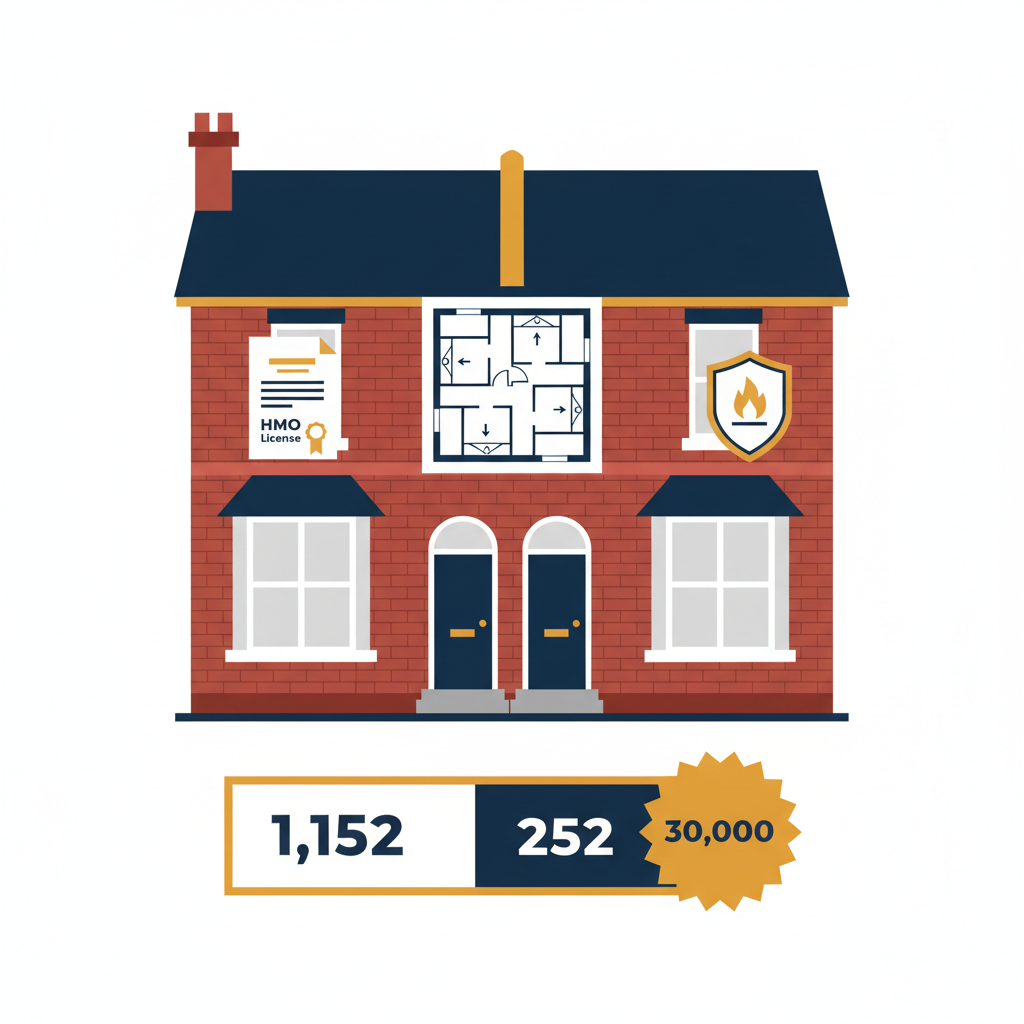
Ealing HMO licence costs from £1,404 for 5 years. Mandatory licensing applies to 5+ occupants. Penalties up to £30,000 for unlicensed HMOs.
Ealing Council currently requires a mandatory HMO licence for any property occupied by 5 or more people forming 2 or more separate households — and failing to hold one can cost landlords up to £30,000 in civil penalties alone.
What Triggers the HMO Licensing Requirement in Ealing?
The threshold that triggers mandatory HMO licensing in Ealing follows the national standard set under the Housing Act 2004, as amended by the Licensing of Houses in Multiple Occupation (Mandatory Conditions) Regulations 2018. If your property is occupied by 5 or more people from 2 or more separate households and they share facilities such as a kitchen or bathroom, you need a licence. This applies regardless of the number of storeys — the 3-storey rule that existed before October 2018 no longer limits the mandatory scheme. A 2-bedroom flat with 5 unrelated occupants sharing a kitchen is therefore caught just as much as a large Victorian terrace. Ealing has not introduced an additional licensing scheme that extends beyond this mandatory threshold as of mid-2025, so landlords should focus on the 5-person rule as the primary trigger.
Permitted development rights and planning use class changes do not remove the licensing obligation. Even where a property has lawful planning permission for HMO use under Class C4 or sui generis, a separate HMO licence from Ealing Council's Housing Licensing team is still legally required.
What Does an Ealing HMO Licence Cost?
Ealing Council charges a 5-year HMO licence fee structured in two parts. The non-refundable application fee is £1,152, payable at the point of submission. A further fee of £252 becomes payable on grant of the licence, bringing the total to £1,404 over the 5-year licence period. This equates to approximately £281 per year, or around £56 per occupant annually for a standard 5-person HMO.
Landlords who are accredited members of a recognised landlord accreditation scheme — such as the London Landlord Accreditation Scheme (LLAS) — may be eligible for a discounted fee. Ealing has historically offered a reduction of £100 on the grant portion of the fee for accredited landlords, though applicants should confirm the current discount directly with the council at the point of application, as these figures are subject to change.
Licence fees are non-transferable. If you sell the property, the new owner must apply for a fresh licence. Budget for a new £1,404 outlay if you acquire a licensed HMO, as the existing licence cannot simply be assigned to you.
How Do You Apply for an HMO Licence in Ealing?
Applications are submitted online through Ealing Council's housing licensing portal. The council targets a decision within 8 weeks of receiving a complete application, though complex cases or properties requiring improvement notices can take considerably longer. You must apply before the property is occupied as an HMO — there is no grace period for retrospective applications on properties already in use.
The application requires you to identify a licence holder (the person responsible for managing the property) and a proposed licence holder if different. Both must pass a fit and proper person assessment, which considers any unspent criminal convictions, previous housing offences, and compliance history with Ealing or other councils. A single relevant conviction — for example, under the Protection from Eviction Act 1977 — can result in refusal.
What Documents Do You Need?
A complete application to Ealing requires the following supporting documents. A current gas safety certificate (renewed annually, so must be in date at submission), an electrical installation condition report (EICR) valid for no more than 5 years, energy performance certificate (EPC) for the property, portable appliance testing (PAT) certificates for any landlord-supplied appliances, and a floor plan drawn to scale showing room dimensions and designated use. Rooms used as sleeping accommodation must meet the national minimum room size of 6.51 square metres for a single adult, or 10.22 square metres for two adults sharing.
Fire safety documentation is also required, including evidence of interlinked smoke alarms on each floor, heat detectors in kitchens, and carbon monoxide detectors in any room with a solid fuel or gas appliance. An automatic fire detection system may be required for larger properties; Ealing's licensing conditions specify the grade and category of system based on occupancy and layout.
What Are the Penalties for Operating Without a Licence in Ealing?
The consequences of operating an unlicensed HMO in Ealing are substantial and operate on multiple fronts simultaneously. The council can issue a civil penalty of up to £30,000 per offence under Section 72 of the Housing Act 2004. Prosecution via magistrates' court carries an unlimited fine. These are not theoretical outcomes — Ealing has an active enforcement team and has pursued unlicensed operators.
Beyond council enforcement, tenants or former tenants can apply to the First-tier Tribunal for a Rent Repayment Order (RRO) covering up to 12 months of rent paid during the period of non-compliance. On a 5-person HMO generating £4,000 per month in total rent, that exposure reaches £48,000 — more than 34 times the cost of the licence itself. Where an RRO is granted, the landlord cannot apply for the rent back through the courts and the order stands regardless of whether the property was otherwise well managed.
A landlord convicted of operating an unlicensed HMO will also fail the fit and proper person test for a period determined by the severity of the offence, which can prevent them from holding an HMO licence across any local authority in England for several years.
What This Means for Ealing Landlords
Ealing's housing enforcement function has become increasingly active, and the 5-occupant threshold catches a broader range of properties than many landlords expect — including purpose-converted flats and properties let to sharers who each have individual tenancy agreements rather than a single joint tenancy. The structure of the tenancy does not determine whether HMO licensing applies; the number of qualifying households and people does.
The £1,404 licence fee represents a manageable compliance cost when viewed against the alternative exposure of up to £30,000 in civil penalties plus potential Rent Repayment Orders. Landlords with properties in Ealing that house 5 or more occupants from 2 or more households should treat the licence application as a priority, not an administrative afterthought.