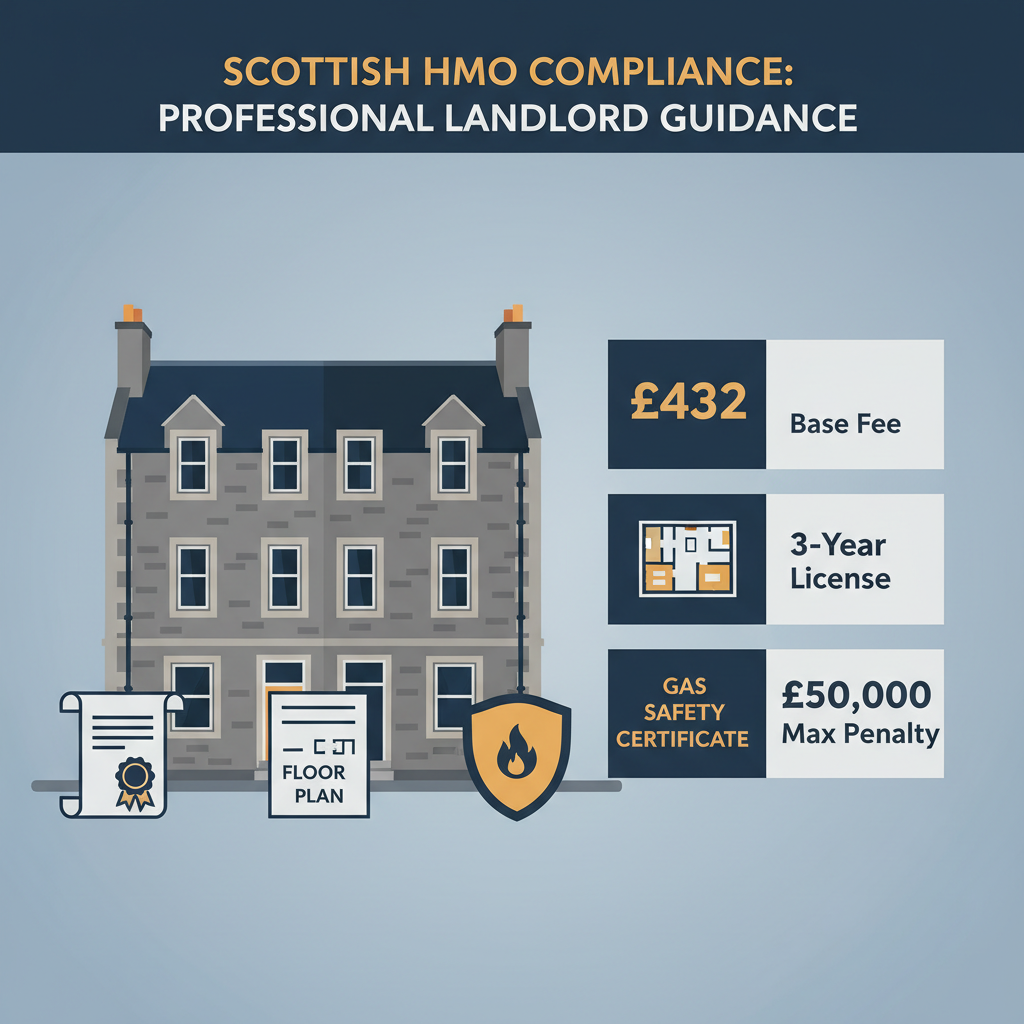
COMPLIANCE ALERT: Operating an unlicensed HMO in Edinburgh carries a fine of up to £50,000 under the Housing (Scotland) Act 2006.
Edinburgh's HMO licensing threshold is 3 unrelated occupants — not 5 as applies in England and Wales — making Scotland's rules significantly stricter for private landlords.
If you own a shared property in Edinburgh and have 3 or more tenants who are not related to one another, you are legally required to hold a House in Multiple Occupation licence issued by the City of Edinburgh Council. This is not optional, and there is no grace period once that third unrelated occupant moves in. Understanding the full scope of this obligation — what triggers it, what it costs, and what happens if you ignore it — is the most important compliance task you face as a landlord operating in the capital.
What Triggers the HMO Licensing Requirement in Edinburgh?
A property in Edinburgh becomes a licensable HMO the moment it is occupied by 3 or more persons from 2 or more separate family units as their only or main residence. The trigger is occupancy, not the number of bedrooms. A 6-bedroom property let to 2 people from the same family does not require a licence; a 3-bedroom flat let to 3 unrelated professionals does. The licence must be in place before the third unrelated occupant takes up residence — not after. Edinburgh City Council operates a mandatory licensing scheme with no upper size threshold, meaning a 20-bed property and a 3-bed flat are both subject to the same statutory framework under the Housing (Scotland) Act 2006.
What Does an Edinburgh HMO Licence Cost?
The City of Edinburgh Council charges a base application fee of £432 for a property with 3 occupants. Fees increase on a sliding scale based on the maximum permitted occupancy. For a property licensed for 5 occupants, the fee rises to approximately £576. For larger properties with 10 or more permitted occupants, fees can exceed £900. These are 3-year licence fees — Edinburgh issues licences for a period of 3 years, not 5 years as is common in some English councils. You must therefore budget for renewal every 3 years, meaning the true cost over a decade is approximately 3 full application cycles. There is no automatic discount for accreditation membership in Edinburgh, unlike some other Scottish councils, but membership of Landlord Accreditation Scotland is taken into account during the fit and proper person assessment.
How Do You Apply for an HMO Licence in Edinburgh?
Applications are submitted directly to the City of Edinburgh Council's Private Sector Housing team. The council requires you to submit your completed application at least 3 months before your existing licence expires, or immediately if this is a first application. The processing time for a new application is typically 12 weeks, though complex cases or properties requiring remedial works can take longer. During that period, the council will arrange a mandatory property inspection carried out by a council officer. The property must meet the physical standards set out in the Licensing of Houses in Multiple Occupation (Scotland) Order 2000, as updated. You will be required to notify your neighbours — any person within 9 metres of the property boundary must receive written notification of your application within 21 days of submission. Neighbours then have 21 days to lodge representations to the council.
What Documents Do You Need to Apply?
You will need to provide the following as part of a complete Edinburgh HMO licence application: a valid Gas Safety Certificate dated within the last 12 months; an Electrical Installation Condition Report (EICR) valid for a maximum of 5 years; an Energy Performance Certificate (EPC) rated E or above (F and G ratings are not acceptable); evidence of working interlinked smoke alarms and heat detectors compliant with Scottish regulations introduced on 1 February 2022; a floor plan of the property showing room dimensions; and public liability insurance with a minimum cover of £5,000,000. All documents must be current at the date of application. A single expired certificate is sufficient grounds for the council to delay or reject your application.
What Are the Penalties for Operating Without a Licence in Edinburgh?
This is where Edinburgh's regime carries serious financial risk. Under the Housing (Scotland) Act 2006, operating an unlicensed HMO is a criminal offence. The maximum financial penalty is £50,000 per property. Edinburgh City Council has actively prosecuted landlords, and convictions result in a criminal record that will affect your ability to pass the fit and proper person test for any future licence application — in Edinburgh or elsewhere in Scotland. In addition, tenants living in an unlicensed HMO have the right to apply to the First-tier Tribunal for Scotland for a Rent Repayment Order covering up to 12 months of rent paid. On a property generating £2,000 per month in rent, that exposure reaches £24,000 — entirely separate from the criminal penalty.
What This Means for Edinburgh Landlords
Edinburgh operates one of the most actively enforced HMO licensing regimes in the United Kingdom. The 3-person threshold, the 3-year licence cycle, and the £50,000 maximum penalty combine to create a compliance environment where mistakes are expensive and ignorance of the rules is not treated as mitigation. If you own a shared tenancy property in Edinburgh, check your current licence status today. If your licence expires within 3 months, begin your renewal application immediately. If you are purchasing a property already operating as an HMO, confirm that the current licence is transferable — Edinburgh licences are not automatically assigned to a new owner, and you must apply for a new licence in your own name within 28 days of completing the purchase.