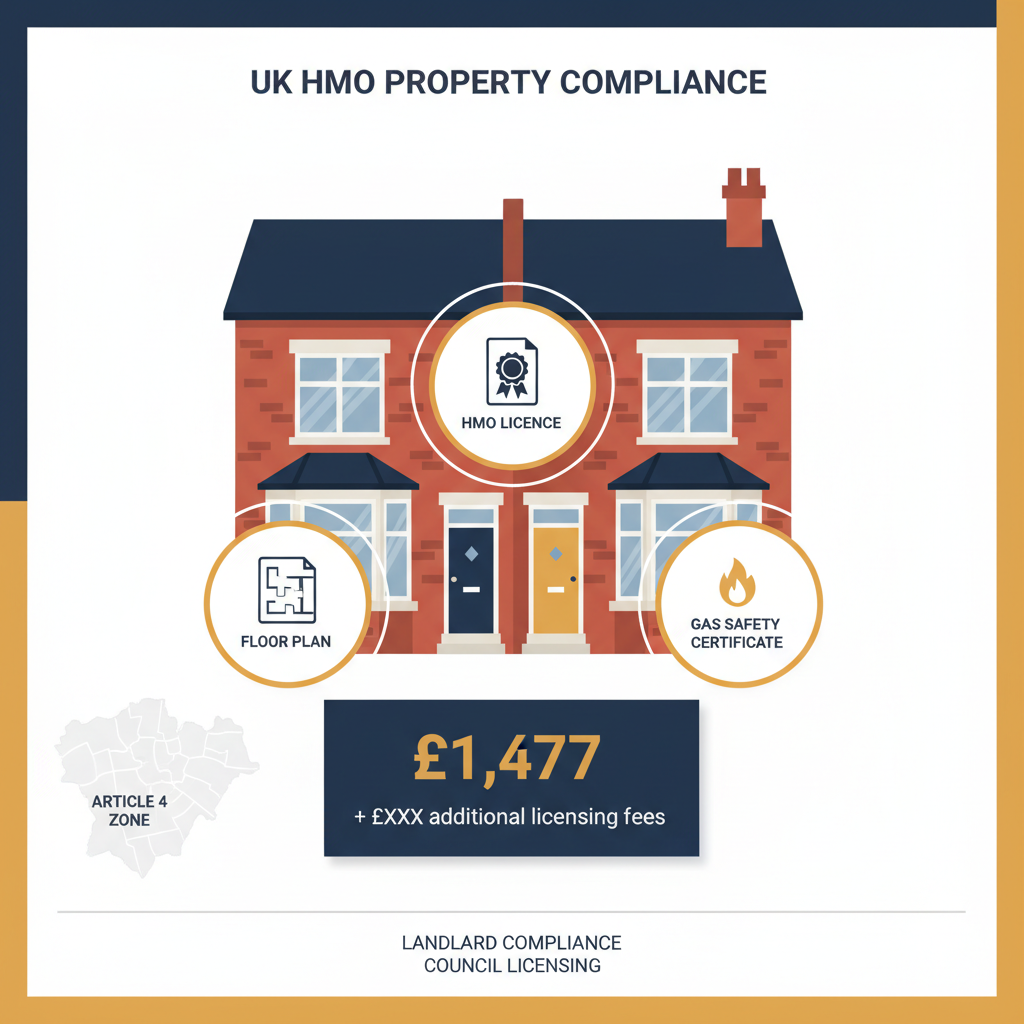
HMO Licensing Birmingham costs £1,477 for a mandatory 5-year licence. Discover Article 4 zones, additional schemes & penalties up to £30,000. UK landlords.
HMO Licensing Birmingham: Fees, Schemes and Article 4
Birmingham landlords face one of the most layered licensing environments in England, with mandatory national licensing, a citywide additional licensing scheme, and Article 4 directions that remove permitted development rights across swathes of the city. The single most important number to know before letting any property to three or more people is £1,477 — that is Birmingham City Council's current mandatory HMO licence fee for a property with five or more occupants sharing facilities, covering a five-year period.
What Triggers an HMO Licence Requirement in Birmingham?
A property becomes a licensable HMO in Birmingham under two separate frameworks, and understanding which applies to your property determines which application you must submit — or whether you need both.
Under mandatory licensing, any property occupied by five or more people forming two or more separate households, who share toilet, bathroom, or kitchen facilities, requires a licence regardless of where in Birmingham it sits. This threshold of five persons has applied nationally since October 2018, when the government extended mandatory HMO licensing to cover smaller properties and those across more than one storey.
The second trigger is Birmingham's additional licensing scheme. Birmingham City Council operates an additional HMO licensing scheme covering properties occupied by three or more people forming two or more households — meaning smaller HMOs that fall below the mandatory threshold still require a licence across much of the city. Landlords must check the precise boundaries of the scheme using the council's postcode checker, as coverage extends to a significant proportion of Birmingham's 73 wards.
The Article 4 direction — designated under the Town and Country Planning Act 1990 — removes the permitted development right that would otherwise allow a change of use from a standard dwelling (Class C3) to a small HMO (Class C4) without planning permission. Birmingham has Article 4 directions in force across multiple areas, including parts of Selly Oak, Edgbaston, Moseley, and the wider south and west of the city. In an Article 4 zone, converting a house into any HMO — even one with just three occupants — requires a full planning application before a licence can be granted. Planning refusal on Article 4 grounds means no licence will follow.
What Does HMO Licensing in Birmingham Cost?
HMO Licensing Birmingham fees are structured in two parts: a non-refundable application processing charge and a licence issue charge. The application fee alone accounts for a portion of the total cost and is retained by the council even if the licence is refused, so ensuring your property meets all standards before applying is essential.
For mandatory licences, Birmingham City Council's current fee sits at £1,477 for the five-year term. For properties falling under the additional licensing scheme, the fee structure is closely aligned, with fees in the range of £900 to £1,200 depending on property size and the number of lettable units. Accredited landlords — those who hold membership with the National Residential Landlords Association (NRLA) or a recognised equivalent — may be eligible for a reduced fee of approximately 10%, which on a mandatory licence represents a saving of around £148.
Renewal applications must be submitted before the expiry of the current licence. Failing to renew on time places the landlord in the same position as an unlicensed operator, with the same financial and legal exposure.
How Do You Apply for an HMO Licence in Birmingham?
Applications are submitted online through Birmingham City Council's portal. The council operates a fit and proper person test, which means every applicant — and every proposed manager of the property — will be assessed against a checklist of criminal convictions, civil penalties, and previous licensing history. A single relevant conviction within the preceding five years can result in refusal.
The application requires details of the property layout, the maximum number of occupants the licence will cover, fire safety measures in place, and the identity of all household members who will manage the property. Processing times currently run at between 8 and 16 weeks from submission of a complete application, so landlords should not wait until a current licence is close to expiry before beginning renewal.
What Documents Do You Need?
Every application requires a minimum set of documents. A valid Gas Safety Certificate must be dated within the 12 months immediately prior to submission. An Electrical Installation Condition Report (EICR) must confirm the installation is satisfactory — under current regulations these must be renewed at least every five years. Energy Performance Certificates, fire alarm test records, and emergency lighting certificates form part of the standard schedule. Where a property has a swimming pool, lift, or LPG supply, additional certificates apply.
Landlords should retain copies of all documents for at least 3 years, as Birmingham City Council's licensing team has the power to conduct inspections and request records at any point during the licence period.
What Are the Penalties for Non-Compliance?
Operating an HMO in Birmingham without a licence, or in breach of licence conditions, is a serious criminal and civil offence. The council may prosecute landlords in the magistrates' court, where historically fines have exceeded £10,000 for a first offence and can theoretically be unlimited. Alternatively, and increasingly commonly, the council issues civil penalties of up to £30,000 per offence — each breach of a licence condition counts as a separate offence, meaning total liability can stack rapidly.
Beyond the direct financial penalty, an unlicensed landlord loses the right to serve a Section 21 no-fault eviction notice until the property is properly licensed. Tenants in unlicensed HMOs may also apply to the First-tier Tribunal for a Rent Repayment Order covering up to 12 months of rent paid — on a Birmingham HMO generating £2,500 per month in rental income, that represents a potential repayment liability of £30,000 from tenants alone, entirely separate from any council penalty.
What Does All This Mean for Birmingham HMO Landlords?
HMO Licensing Birmingham is not a one-time administrative task — it is an ongoing compliance framework with hard deadlines, fee obligations, and document schedules that repeat on five-year cycles. Landlords with properties in Article 4 zones face the additional burden of securing planning permission before a licence application can succeed, adding months and potentially thousands of pounds in planning fees and agent costs to any new acquisition or conversion. The council's enforcement activity has increased materially since 2021, with the number of civil penalties issued rising year-on-year. The cost of getting this wrong — financially, legally, and in terms of future licensing eligibility — substantially exceeds the cost of compliance.