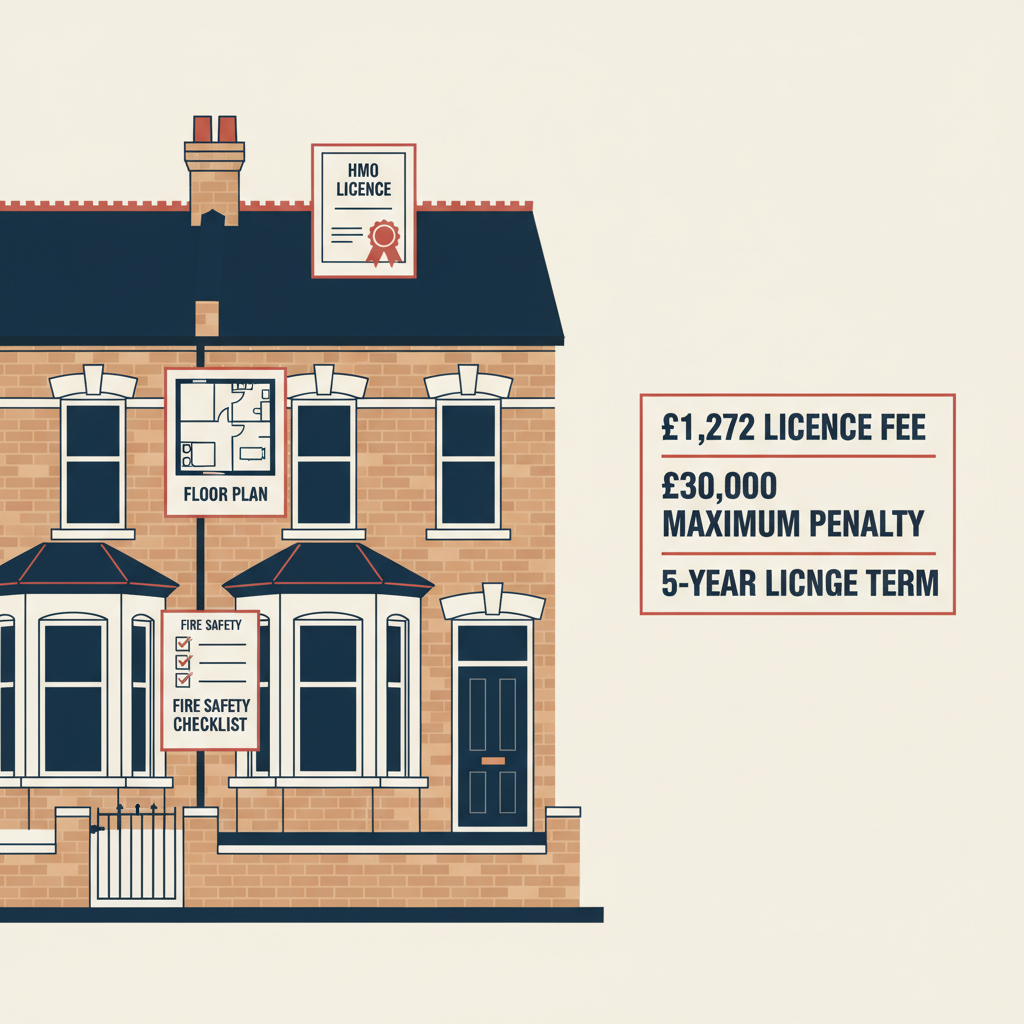
Greenwich HMO licence costs £1,272 for 5 years. Mandatory licensing applies to properties with 5+ occupants. Apply before occupying to avoid a £30,000 fine.
HMO Licensing in Greenwich: The Complete Compliance Guide for Private Landlords
The single most important figure every Greenwich landlord needs to know is this: a mandatory HMO licence costs £1,272 for a five-year term, and you must hold one before a single tenant moves in if your property meets the threshold. Get that wrong and the Royal Borough of Greenwich can issue a civil penalty of up to £30,000 — or pursue an unlimited fine through the criminal courts.
What triggers the HMO licensing requirement in Greenwich?
Mandatory HMO licensing is triggered by a nationally set threshold: your property must be occupied by 5 or more people forming 2 or more separate households, sharing facilities such as a kitchen or bathroom. This applies to properties of any storey count following the government's 2018 extension of mandatory licensing, which removed the previous 3-storey requirement. If your property sits below that threshold — say 4 occupants across 2 households — you fall outside mandatory licensing, though Greenwich's additional or selective licensing schemes may still apply depending on the ward.
Greenwich operates both mandatory and additional HMO licensing. The additional licensing scheme, which was renewed and extended to run until October 2026, captures smaller HMOs with as few as 3 occupants in 2 or more households. If your property falls in a designated ward, you need a licence regardless of whether you hit the 5-person mandatory threshold. Always check the current scheme map on the Royal Borough of Greenwich website to confirm whether your specific postcode is included, as the designated areas were last revised in 2021.
What does an HMO licence in Greenwich cost?
The mandatory HMO licence fee in Greenwich is £1,272, covering a 5-year licence period. The fee is split into two stages: Part A (the non-refundable processing fee, approximately £412) is payable on application, and Part B (the remainder of approximately £860) is due on licence approval. If your application is refused, you do not receive the Part A portion back, so ensuring your property is compliant before applying is essential.
For additional licensed HMOs, Greenwich charges a separate fee structure. Smaller HMOs with 3 to 4 occupants under the additional licensing scheme attract a reduced fee, typically around £900 for the 5-year term. Accredited landlords who are members of a recognised scheme such as the National Residential Landlords Association (NRLA) or a local accreditation body may be eligible for a modest discount — historically around 10% — though you should confirm the current discount directly with Greenwich's private housing team before applying.
How do you apply for an HMO licence in Greenwich?
Applications are submitted online through the Royal Borough of Greenwich's licensing portal. There is no paper-based route for new applications. You will need to create an account, complete the property and management details, upload supporting documents, and pay the Part A fee in a single session, so gather everything before you begin. Processing times vary, but applicants should expect an initial response within 8 weeks for straightforward cases. Complex applications, or those requiring a fit and proper person investigation, can take considerably longer.
The licence is property-specific, not portable. If you acquire a second qualifying HMO anywhere in Greenwich, a separate £1,272 application is required for that address. Licences are also non-transferable on sale, so any buyer of your licensed HMO must apply in their own name within 7 days of completion.
What documents do you need to apply?
Greenwich requires a specific set of documents at the point of application. You will need a current gas safety certificate (valid within the last 12 months), an electrical installation condition report (EICR) no older than 5 years, a current energy performance certificate (EPC) rated E or above — a rating of F or G will result in refusal — and up-to-date fire risk assessment documentation. You must also supply a floor plan showing room dimensions and usage, a current tenancy agreement or evidence of occupation, and proof of public liability insurance with a minimum cover of £1,000,000. Missing any one of these at the point of submission risks rejection of the Part A payment stage and delays your compliance timeline.
What happens if you operate without a licence in Greenwich?
The consequences of non-compliance are serious and escalating. Under the Housing Act 2004, operating an unlicensed HMO is a criminal offence carrying an unlimited fine on conviction. Alternatively, Greenwich can pursue a civil penalty of up to £30,000 per property without going to court. Beyond the financial penalty, tenants in an unlicensed HMO have an automatic right to apply for a Rent Repayment Order (RRO) covering up to 12 months of rent paid. On a Greenwich HMO generating £3,000 per month in rent, that RRO exposure alone reaches £36,000 — significantly more than the cost of the licence itself.
Landlords found operating unlicensed properties are also likely to fail the fit and proper person test for any future licence applications across any London borough, creating a long-term barrier to operating legally.
What does this mean for your property in practice?
For any landlord currently letting or planning to let a property in Greenwich to 3 or more unrelated people, the compliance question is not optional. The 2018 expansion of mandatory licensing, combined with Greenwich's active additional licensing scheme running to October 2026, means the majority of shared houses in the borough require a licence. Budget £1,272 plus your compliance documentation costs — EICR inspections typically cost between £150 and £300 depending on property size — before your first tenancy begins, not after your first inspection notice arrives.
Greenwich's environmental health team conducts proactive inspections and also responds to tenant complaints. With 4 in 10 enforcement actions in London now resulting in a formal civil penalty rather than a warning, the probability of a fine for an unlicensed landlord in the borough has never been higher.