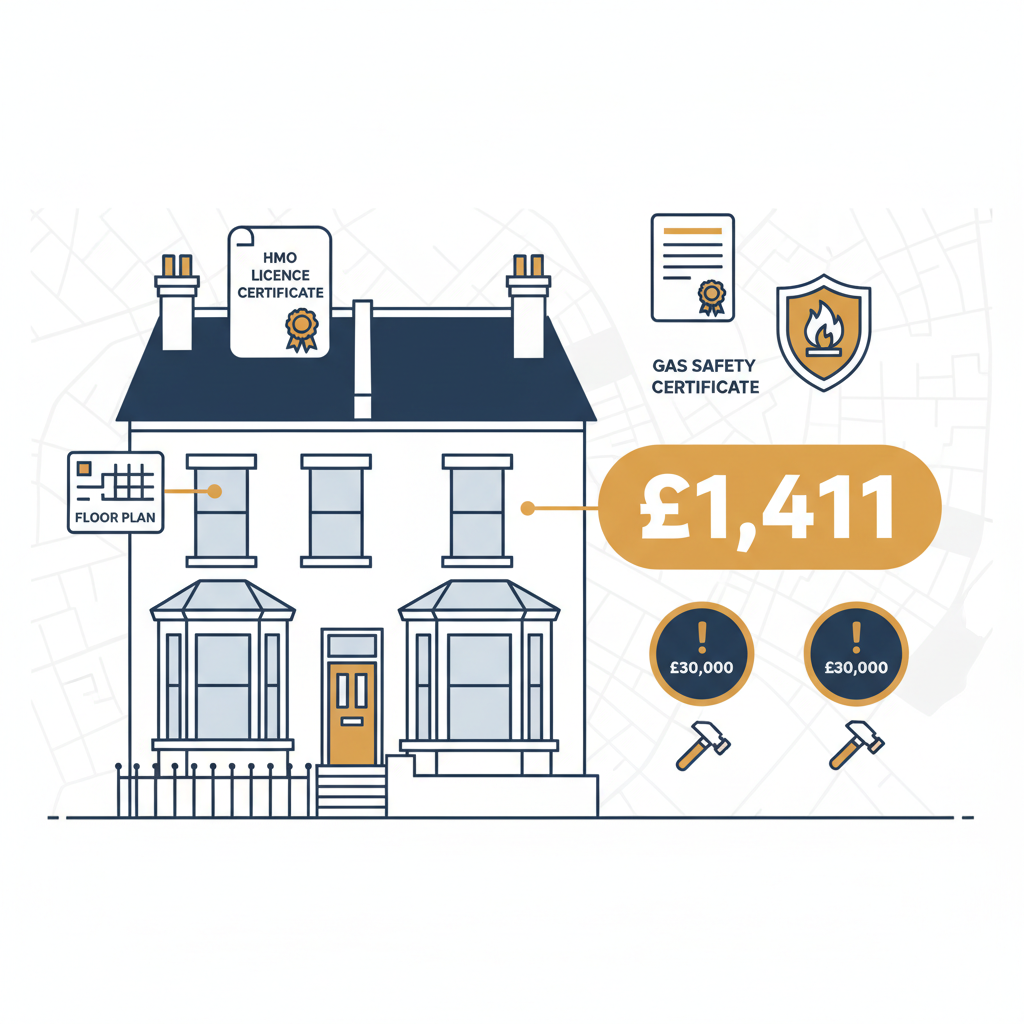
Kensington and Chelsea HMO licence costs from £1,411 for 5 years. Learn thresholds, application steps and fines up to £30,000 for non-compliance.
HMO Licensing in Kensington and Chelsea: Fees, Thresholds and How to Apply
The single most critical fact for any landlord renting out a shared property in this borough: if your property houses 5 or more people forming 2 or more separate households, you are legally required to hold a mandatory HMO licence under the Housing Act 2004, and the Royal Borough of Kensington and Chelsea will charge you a minimum of £1,411 for a 5-year licence.
What Triggers the HMO Licensing Requirement in Kensington and Chelsea?
Mandatory HMO licensing is triggered when a property is occupied by 5 or more people from 2 or more separate households who share facilities such as a kitchen or bathroom. This threshold applies across England under national legislation, and Kensington and Chelsea enforces it actively given the density of shared housing in areas such as North Kensington, Earls Court and Notting Hill.
Beyond the mandatory scheme, Kensington and Chelsea also operates an Additional Licensing scheme, which captures smaller HMOs occupied by 3 or more people from 2 or more households. This means a property with just 3 tenants sharing a kitchen can require a licence in this borough, even though it would not require one under national mandatory rules alone. Landlords must check both schemes before assuming a property falls outside the licensing net. The Additional Licensing designation covers the entire borough, which spans approximately 4.7 square miles of central and west London.
What Does an HMO Licence Cost in Kensington and Chelsea?
The fee structure for Kensington and Chelsea is split into two stages, which is standard practice for London boroughs. The application fee of £836 is paid upfront and is non-refundable, even if the application is refused. The second stage fee of £575 becomes payable once the licence is granted, bringing the total to £1,411 for a 5-year licence. This works out at approximately £282 per year.
Accredited landlords who hold membership with a recognised landlord accreditation scheme, such as the London Landlord Accreditation Scheme (LLAS), may be eligible for a reduced fee. The LLAS discount can reduce the total licence fee by up to £100, though landlords should confirm the current discount directly with the council as figures are subject to periodic review. Licences run for a maximum of 5 years, after which renewal applications and fees apply in full.
What Are the Application Requirements?
Applications for HMO licensing in Kensington and Chelsea are submitted online through the council's licensing portal. Before submitting, landlords must ensure the property meets the statutory minimum room size standards introduced in October 2018. Under these regulations, rooms used for sleeping by a single adult must be at least 6.51 square metres, and rooms shared by 2 adults must be at least 10.22 square metres. Rooms used by children under 10 must be no smaller than 4.64 square metres. Properties that fail these thresholds will not receive a licence.
The application requires the landlord or managing agent to confirm the property's current occupancy, the number of storeys, the layout of shared facilities, and the condition of fire safety measures including interlinked smoke alarms and fire doors where required. A fit and proper person declaration must be completed for every licence holder and any named manager.
What Documents Do You Need to Submit?
The council requires a specific set of supporting documents before it will process an application. These include a valid gas safety certificate dated within the last 12 months, an Electrical Installation Condition Report (EICR) dated within the last 5 years, and an Energy Performance Certificate (EPC). Fire safety documentation is also required, including confirmation of interlinked smoke and heat alarm provision on every floor. Landlords must also provide a floor plan of the property and proof of ownership or authority to act as manager. Missing even one of these documents will delay the application, and the council targets a processing time of 20 working days from receipt of a complete submission.
What Are the Penalties for Operating Without a Licence?
Operating an unlicensed HMO in Kensington and Chelsea is a serious criminal and civil matter. The council can issue a civil penalty of up to £30,000 per breach, and this figure can be applied separately to each offence, meaning a landlord with multiple unlicensed properties could face combined penalties well into six figures. Alternatively, the council may prosecute through the magistrates' court, where an unlimited fine can be imposed.
Beyond financial penalties, an unlicensed landlord loses the right to serve a valid Section 21 notice to regain possession of the property. Tenants can also apply to the First-tier Tribunal for a Rent Repayment Order (RRO), which can require the landlord to repay up to 12 months' worth of rent — a figure that in Kensington and Chelsea, where average room rents exceed £900 per month in many streets, can represent a substantial sum.
What This Means for Landlords in Kensington and Chelsea
Kensington and Chelsea is one of the most actively enforced boroughs in London for HMO compliance, and the combination of mandatory and additional licensing means the overwhelming majority of shared properties require a licence. With fees totalling £1,411, penalties reaching £30,000, and the risk of rent repayment orders covering up to 12 months of income, the cost of non-compliance vastly exceeds the cost of proper licensing. Any landlord with a property occupied by 3 or more people from separate households should assume a licence is required and verify this directly with the Royal Borough of Kensington and Chelsea before the next tenancy begins.