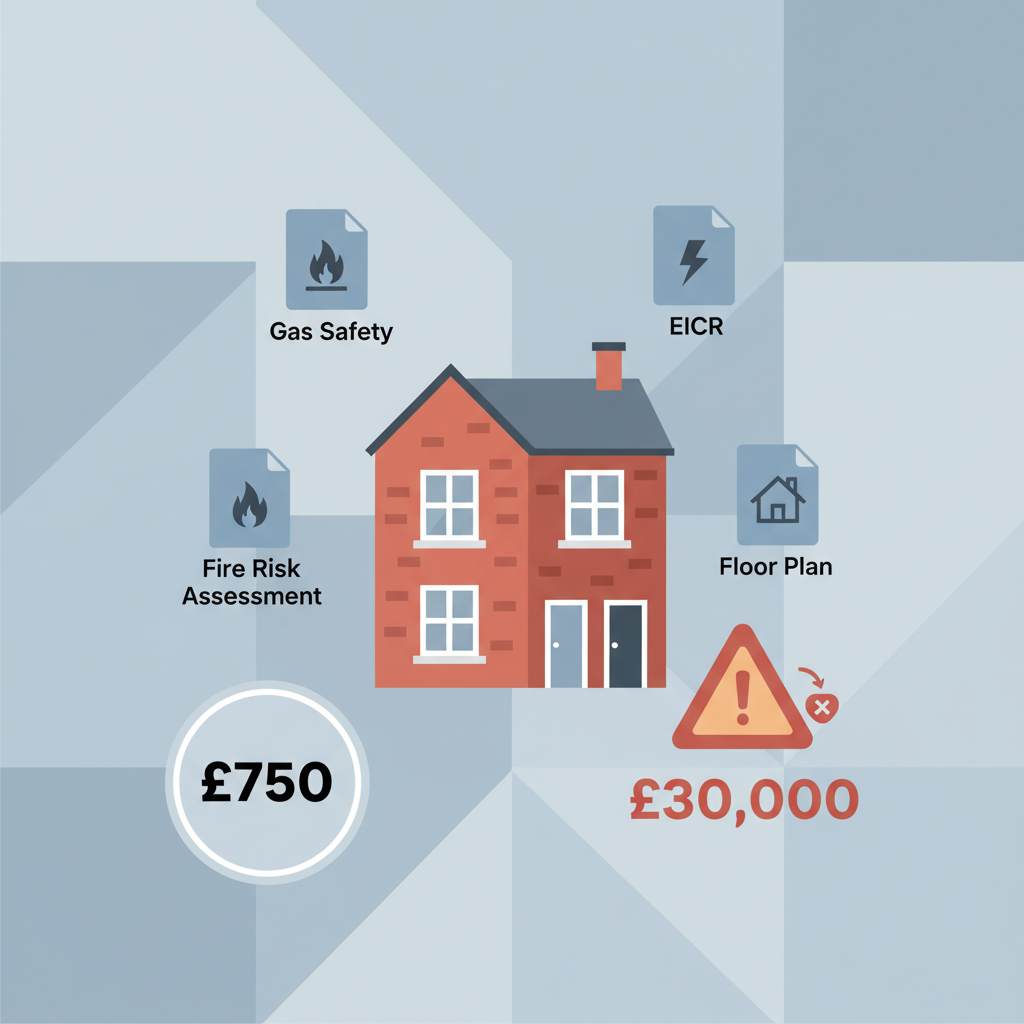
Stoke-on-Trent Council can issue fines of up to £30,000 for operating an unlicensed HMO — applications must be submitted before occupation begins.
Stoke-on-Trent's mandatory HMO licence fee starts at £750 for a 5-year licence covering properties with 5 or more occupants forming 2 or more households. That single figure is the most critical number for any landlord operating shared accommodation in the city. If your property meets that threshold and you have not submitted a licence application, you are already in breach of the Housing Act 2004, regardless of how well-managed the property is.
What triggers mandatory HMO licensing in Stoke-on-Trent?
Mandatory licensing in Stoke-on-Trent applies to any property occupied by 5 or more persons from 2 or more separate households, sharing facilities such as a kitchen or bathroom. This definition was extended nationally in October 2018 to remove the previous 3-storey rule, meaning single and two-storey properties now fall within scope. A 3-bedroom house occupied by 5 unrelated individuals in Shelton or Cobridge, for example, requires a full mandatory HMO licence. Stoke-on-Trent City Council also retains the power under Part 2 of the Housing Act 2004 to designate additional licensing schemes covering smaller HMOs — properties occupied by 3 or 4 persons — so landlords should monitor council announcements for any expansion of scheme coverage beyond the current mandatory threshold.
Does Stoke-on-Trent have additional or selective licensing?
As of the current council position, Stoke-on-Trent operates mandatory HMO licensing across the entire city boundary rather than a borough-wide additional licensing scheme. However, the council's Private Sector Housing team has powers to introduce additional licensing covering 3- and 4-person HMOs, which would reduce the occupancy trigger from 5 to 3 persons. Any such designation requires a minimum 10-week public consultation period and Secretary of State confirmation if it covers more than 20% of the council's private rented stock. Landlords with smaller shared properties in high-demand student areas such as Stoke or Hartshill should treat this as a live risk and check the council's licensing register, which is publicly searchable, every 6 months.
What are the exact HMO licence fees in Stoke-on-Trent?
Stoke-on-Trent City Council structures its mandatory HMO licence fee on a per-application basis for a 5-year term. The base fee is £750 for a standard application. This covers the processing, inspection and administration costs associated with a new licence. Renewal applications, where the property has a compliant licence history, are processed at the same rate. There is no published accreditation discount for membership of bodies such as the National Residential Landlords Association, though landlords should confirm this directly with the Private Sector Housing team on 01782 234234, as council fee schedules are subject to annual review. Fees are non-refundable once an application has been validated, even if the licence is ultimately refused following inspection.
How do you apply for an HMO licence in Stoke-on-Trent?
Applications are submitted through Stoke-on-Trent City Council's online portal via the Gov.uk licensing gateway or directly through the council's website. The application requires 9 core documents as standard: proof of ownership or management authority, a current gas safety certificate (valid within 12 months), an electrical installation condition report (EICR) valid for 5 years, energy performance certificate, fire risk assessment, floor plan to scale, details of all occupants, a proposed statement of conditions, and public liability insurance evidence showing a minimum of £1,000,000 cover. Missing any 1 of these 9 documents will result in the application being returned as invalid, resetting the processing clock. The council's target determination period is 12 weeks from validated receipt.
What does Stoke-on-Trent Council inspect during the licensing process?
Once an application is validated, a housing officer from Stoke-on-Trent's Private Sector Housing team will arrange a physical inspection of the property. Officers apply the Housing Health and Safety Rating System (HHSRS) across 29 hazard categories. Room size standards are enforced strictly: sleeping rooms for a single adult must be a minimum of 6.51 square metres, and rooms for 2 adults must be at least 10.22 square metres. Children under 10 years occupying a sleeping room trigger a minimum of 4.64 square metres. Kitchens, bathrooms and means of escape are assessed against the council's own amenity standards schedule. Any Category 1 hazard identified during inspection can result in the council issuing an Emergency Prohibition Order within 24 hours, preventing occupation entirely regardless of the licence application status.
What enforcement action does Stoke-on-Trent take against unlicensed HMOs?
Stoke-on-Trent City Council's enforcement approach is governed by the Housing and Planning Act 2016, which introduced Civil Penalty Notices as an alternative to criminal prosecution. Operating an unlicensed HMO can attract a Civil Penalty of up to £30,000 per offence, issued by the council without requiring a court hearing. The council may also prosecute through the magistrates' court, where the maximum unlimited fine applies under the Legal Aid, Sentencing and Punishment of Offenders Act 2012. Beyond the financial penalty, landlords convicted of HMO offences are entered onto the Rogue Landlord Database, maintained under Section 29 of the Housing and Planning Act 2016, and can be subject to a Banning Order lasting a minimum of 12 months — effectively preventing them from letting any residential property in England.
Can tenants claim rent back for an unlicensed HMO in Stoke-on-Trent?
Yes. Under Section 73 of the Housing Act 2004, tenants in an unlicensed HMO in Stoke-on-Trent can apply to the First-tier Tribunal (Property Chamber) for a Rent Repayment Order (RRO). The tribunal can order repayment of up to 12 months' rent. In a property charging £500 per room with 5 tenants, the maximum exposure is £30,000 in repaid rent — entirely separate from and in addition to any Civil Penalty Notice issued by the council. This dual liability makes delayed applications one of the most financially damaging decisions a Stoke-on-Trent landlord can make.