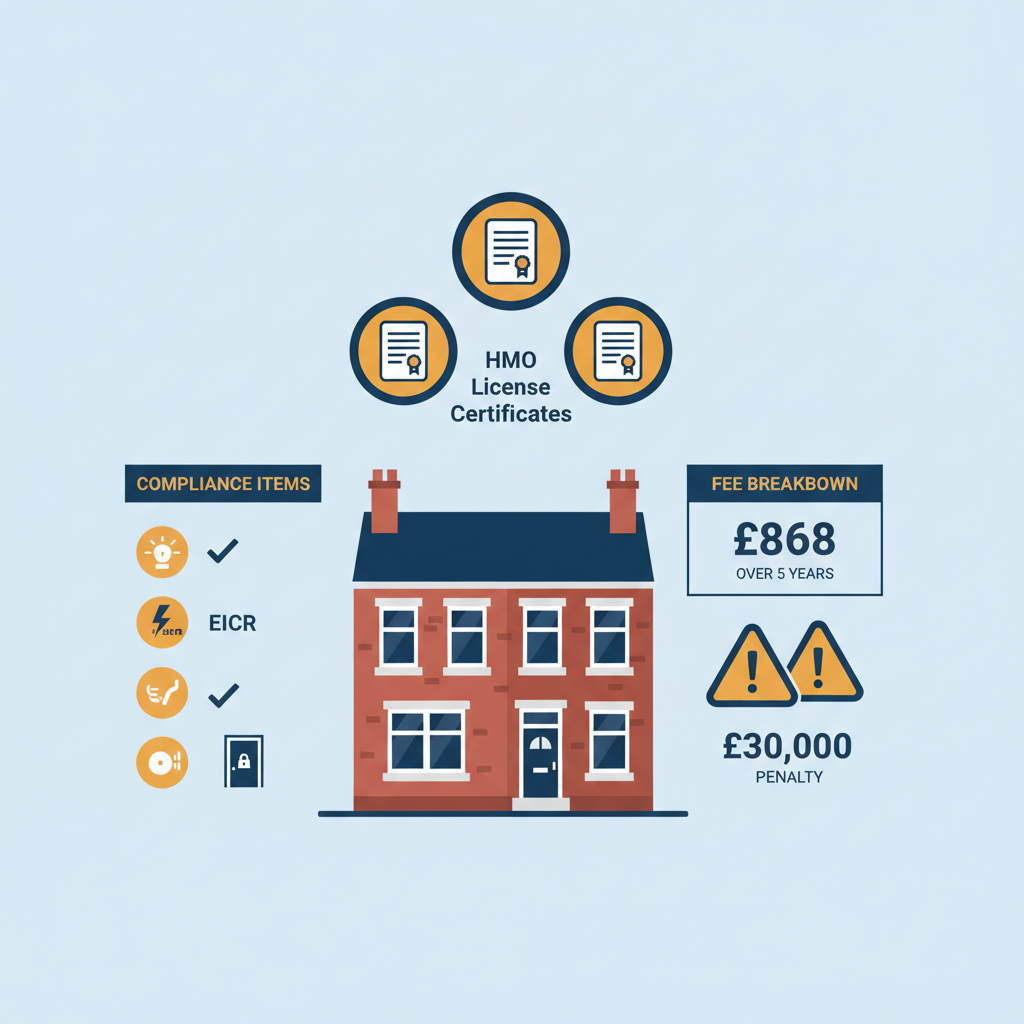
Operating an unlicensed HMO in Wolverhampton carries an unlimited civil penalty of up to £30,000 per property — apply before occupation.
Wolverhampton City Council charges £868 for a 5-year mandatory HMO licence, making it one of the more competitively priced licensing authorities in the West Midlands. That figure applies to a standard 5-person HMO and is non-refundable once the application is processed, so landlords must ensure their property meets the prescribed standards before submitting. This single fee covers the full 5-year licence term, which means an annualised compliance cost of approximately £173.60 per year — modest compared to the penalties for non-compliance.
What triggers HMO licensing in Wolverhampton?
Mandatory HMO licensing in Wolverhampton is triggered when a property is occupied by 5 or more persons forming 2 or more separate households, across 3 or more storeys. This reflects the national mandatory threshold introduced by the Housing Act 2004 and amended by the Licensing of Houses in Multiple Occupation (Mandatory Conditions) (England) Regulations 2018. However, Wolverhampton City Council also operates an Additional Licensing Scheme covering smaller HMOs of 3 or more occupants forming 2 or more households in designated wards. Landlords must therefore determine which scheme applies to their specific postcode before assuming only mandatory licensing is relevant. Properties in the WV1, WV2, WV3, WV10 and several adjoining postcode areas are subject to additional licensing requirements, extending the net well beyond the 5-person national threshold.
What are the exact HMO licence fees in Wolverhampton?
Wolverhampton City Council structures its fees in 2 parts for mandatory licensing. The application processing element is paid upfront and is non-refundable at approximately £433. The second instalment of approximately £435 is due upon grant of the licence. The total 5-year cost of £868 covers properties with up to 5 occupants. For larger HMOs accommodating 6 or more persons, an additional charge per extra occupant applies, typically around £50 per additional occupant above the 5-person threshold. Landlords holding membership with an approved accreditation body may be eligible for a reduction, though Wolverhampton's current published schedule should always be consulted directly as fees are subject to periodic review. The licence runs for a maximum of 5 years and cannot be transferred on sale — any change of ownership requires a fresh application.
How do you apply for an HMO licence in Wolverhampton?
Applications must be submitted via Wolverhampton City Council's online licensing portal. You will need a completed application form, a current gas safety certificate (renewed annually), an electrical installation condition report (EICR) valid for no more than 5 years, evidence of working smoke and heat alarms on every floor, emergency lighting documentation, floor plans drawn to a scale of 1:50 or 1:100, and proof of planning permission or a lawful development certificate where applicable. The council targets a decision within 8 weeks of receiving a complete application, though complex cases may extend to 12 weeks. During this period, a temporary licence may be issued at the council's discretion. Landlords should not wait for the licence to arrive before occupying the property — if 5 or more occupants are in residence and no licence is held, the offence is already being committed. Submit at least 12 weeks before intended occupation to allow processing time.
What enforcement action does Wolverhampton take against unlicensed HMOs?
Wolverhampton City Council's housing enforcement team actively cross-references council tax records, utility data and planning records to identify unlicensed HMOs. The council issued 47 civil penalties in 2022–23 relating to HMO licensing offences, with average penalties in that period exceeding £10,000 per case. A civil penalty of up to £30,000 can be imposed per offence under the Housing and Planning Act 2016, and unlike prosecution in the Magistrates' Court, civil penalties do not require the burden of a criminal standard of proof. The council can also issue an Interim or Final Management Order, effectively taking control of the property for up to 5 years. In addition, any rent received during the period of unlicensed operation can be reclaimed by tenants via a Rent Repayment Order covering up to 12 months of rent, which at current Wolverhampton rental levels can amount to between £7,200 and £18,000 depending on the size of the HMO.
What are the penalties for breaching HMO licence conditions in Wolverhampton?
Holding a licence but breaching its conditions is a separate offence from operating without a licence entirely. Wolverhampton City Council can issue a civil penalty of up to £5,000 for a breach of licence conditions under Section 234 of the Housing Act 2004. Common breaches include failing to maintain fire safety equipment, overcrowding beyond the licensed number of occupants, failing to display the licence, and failing to provide tenants with the required documentation within 28 days of request. Repeat breaches can result in licence revocation and the individual being entered onto the national rogue landlord database, which triggers automatic review of any other licences held. A banning order under the Housing and Planning Act 2016 can prohibit a landlord from managing or letting any residential property in England for a minimum of 1 year and in serious cases indefinitely.
When does the Wolverhampton Additional Licensing Scheme expire?
The current Additional Licensing Scheme in Wolverhampton was confirmed for a 5-year term and landlords operating in designated areas must ensure they are licenced for the duration of that scheme. Any property falling within scope on the scheme's commencement date required a licence application within 3 months of that date. Failure to apply within that 3-month grace period removed any reasonable excuse defence. Wolverhampton City Council reviews its designation every 5 years and a fresh consultation is required before renewal. Landlords with properties near the boundary of designated wards should write to the council directly for a formal determination of whether their specific address falls within scope — a verbal assurance from a housing officer is not a legal defence.