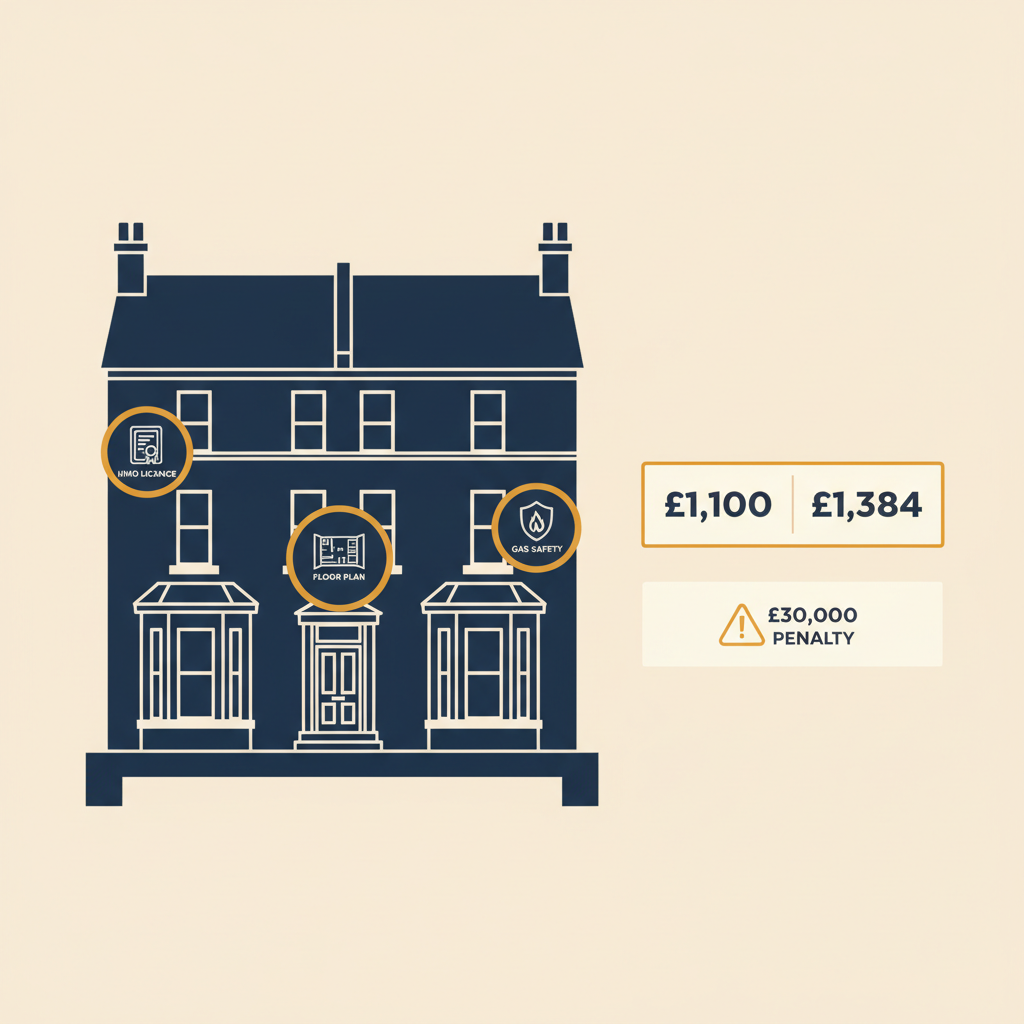
Islington HMO licence costs from £1,384. Know the occupancy thresholds, application steps and penalties before your next tenancy starts.
Islington HMO Licensing: Everything Private Landlords Must Know
If you own a property in Islington let to 3 or more unrelated people sharing facilities, you may already be breaking the law — and the council has issued civil penalties exceeding £20,000 to landlords who failed to act.
What Triggers an HMO Licensing Requirement in Islington?
The first question landlords ask is whether their property actually needs a licence. The answer depends on two overlapping frameworks. Mandatory HMO licensing applies nationally to any property occupied by 5 or more people forming 2 or more households, across 2 or more storeys — this is the standard statutory definition under the Housing Act 2004. However, Islington Council operates an Additional Licensing Scheme that extends this requirement significantly further. Under Islington's additional scheme, any property let to 3 or more people from 2 or more households and used as an HMO requires a licence, regardless of the number of storeys. This lower threshold means a first-floor flat shared by 3 colleagues is licensable in Islington even if it would be exempt elsewhere.
The additional scheme has been in place in various forms since 2015. Landlords who purchased or converted properties in the borough after that date and have not held a licence should seek to regularise their position without delay, as the council actively cross-references land registry data, council tax records and tenancy deposit information to identify unlicensed properties.
What Does an HMO Licence Cost in Islington?
Islington charges a two-part fee structure for HMO licences. For mandatory HMO licences, the current fee is approximately £1,384 for properties with up to 5 occupants, with additional charges applied per room above that threshold. Additional licensing fees begin at around £1,100 for smaller qualifying properties. Both licence types run for 5 years, meaning the annual cost works out to roughly £277 per year for a standard mandatory HMO — broadly comparable to other inner-London boroughs. Accredited landlords registered with the London Landlord Accreditation Scheme (LLAS) or a recognised body may be eligible for a fee reduction of up to 10%, which should be confirmed directly with Islington's private sector housing team before submitting an application.
There is no fee waiver for first-time applicants, and fees are non-refundable if an application is refused, so ensuring your property meets the required standards before applying is essential.
How Do You Apply for an HMO Licence in Islington?
Applications are submitted through Islington Council's online licensing portal. The process requires creating an account, completing the property and management sections of the form, uploading supporting documents and paying the fee in full at the point of submission. The council aims to determine applications within 12 weeks of receiving a complete submission, though complex cases or those requiring an inspection can take longer. Properties that have not previously been licensed or that show evidence of works may be prioritised for a physical inspection visit, typically conducted within 4 weeks of the application being validated.
If the council grants a licence with conditions — such as requiring fire door upgrades within 3 months of the licence date — failure to comply with those conditions within the stated timeframe can itself trigger a civil penalty, separate from any penalty for unlicensed operation.
What Documents Do You Need to Apply?
Islington requires a specific set of documentation at the point of application. You will need a current gas safety certificate (valid within the last 12 months), an electrical installation condition report (EICR) dated within the last 5 years, a recent energy performance certificate (EPC), proof of working smoke alarms on every floor and carbon monoxide detectors in rooms with solid fuel or gas appliances. A floor plan drawn to scale showing room dimensions is required because Islington enforces minimum room sizes: a single bedroom must be at least 6.51 square metres, and a room used by two people must be at least 10.22 square metres. Rooms below these sizes cannot lawfully be let as sleeping accommodation. You will also need to provide details of your property management arrangements and, where a managing agent is used, their details and the terms of the management agreement.
What Happens If You Don't Have a Licence?
Operating an unlicensed HMO in Islington is a serious criminal offence under Section 72 of the Housing Act 2004. The council can prosecute in the magistrates' court, where there is no upper limit on the fine that can be imposed. Alternatively — and increasingly commonly — Islington uses its civil penalty powers under the Housing and Planning Act 2016 to issue fixed penalties of up to £30,000 per offence without the need for prosecution. Landlords who receive a civil penalty retain the right of appeal to the First-tier Tribunal within 28 days of receiving the notice.
Beyond financial penalties, tenants in an unlicensed HMO have an automatic right to apply for a Rent Repayment Order (RRO) covering up to 12 months of rent paid during the period of unlicensed operation. In a 3-bedroom Islington HMO let at current market rents, that could represent a repayment liability exceeding £30,000 — in addition to any penalty the council itself imposes. Landlords subject to a successful RRO may also be listed on the Mayor of London's rogue landlord database, which affects future licensing applications across all London boroughs.
What This Means for Islington Landlords
Islington is one of the most active inner-London boroughs for HMO enforcement. The combination of a low 3-person threshold under the additional licensing scheme, a proactive investigations team and automatic RRO rights for tenants means the risk of non-compliance is not theoretical — it is a live financial exposure. The 5-year licence fee, while a meaningful upfront cost, represents a fraction of the potential liability. Landlords with properties across multiple boroughs should note that Islington's additional scheme area covers the entire borough, so there are no postcode exemptions within the local authority boundary. Review your portfolio now: if any property in Islington houses 3 or more unrelated tenants, it almost certainly requires a licence.