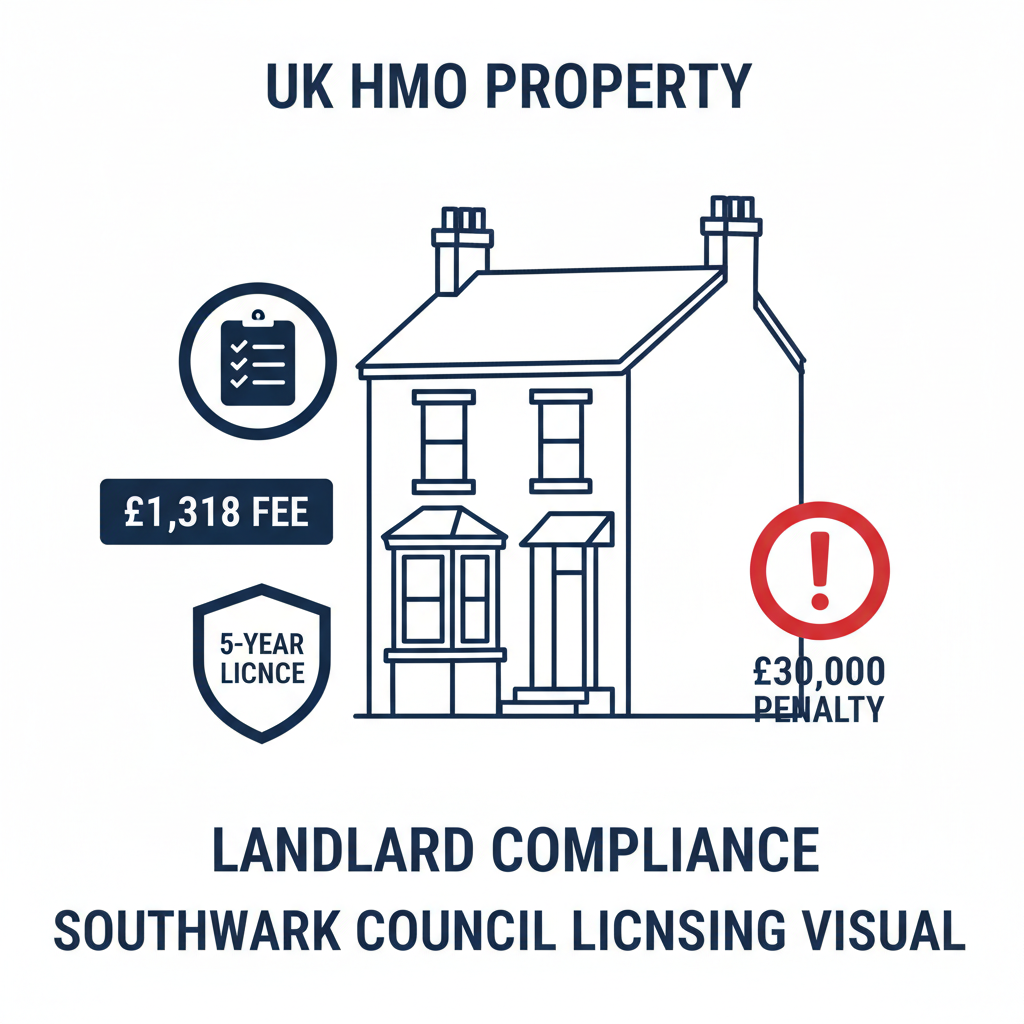
Southwark HMO licence costs from £1,318 for 5 years. Mandatory and additional licensing rules, thresholds, and penalties for unlicensed landlords explained.
Southwark Council requires a licence for every house in multiple occupation that meets the mandatory national threshold or falls within its additional licensing designation — and the consequences of getting this wrong now reach £30,000 per property.
What Triggers HMO Licensing in Southwark?
The mandatory national HMO licensing threshold applies across England: any property occupied by 5 or more persons forming 2 or more separate households, sharing facilities such as a kitchen or bathroom, must hold a mandatory HMO licence. In Southwark, this applies borough-wide with no exemptions for property type or tenure length. Additionally, Southwark operates an Additional Licensing Scheme covering smaller HMOs with 3 or 4 occupants forming 2 or more households, which brings a substantial proportion of the borough's shared housing stock into the licensing net. As of the most recent scheme renewal, this additional designation covers all 21 wards in the borough. Landlords must assess their property against both triggers — mandatory and additional — before assuming they are exempt.
A property also becomes licensable if it is a converted block of flats that does not comply with the 1991 Building Regulations and less than two-thirds of the flats are owner-occupied, provided it has 3 or more units. This catch catches many older converted Victorian terraces that are common in areas such as Peckham and Bermondsey.
What Does an HMO Licence Cost in Southwark?
Southwark Council charges a 5-year HMO licence fee structured in two parts. The non-refundable application fee covers administrative processing and is paid at the point of submission. The total mandatory HMO licence fee is approximately £1,318 for a standard property, though this figure is subject to periodic revision and landlords should confirm the current schedule directly with the council's private rented sector team before submitting.
For properties falling under the additional licensing scheme, fees follow a comparable structure but may vary slightly by property size and household number. Some councils in London offer a 10% to 15% reduction for accredited landlords who are members of recognised schemes such as the London Landlord Accreditation Scheme (LLAS). Southwark has historically recognised accreditation status as a mitigating factor in fee calculations, though this must be declared at the point of application. A licence runs for a maximum of 5 years, meaning landlords must budget for renewal costs and should diarise the expiry date from day one to avoid inadvertent lapse into unlicensed operation.
How Do You Apply for an HMO Licence in Southwark?
Applications are submitted online through Southwark Council's licensing portal. The process requires the nominated licence holder — who must be the most appropriate person and is typically the landlord or a named property manager — to complete a detailed declaration covering the property's physical condition, management arrangements, and occupancy. Processing times vary, but applicants should allow at least 8 to 12 weeks for a decision on a complete, uncontested application. Incomplete submissions reset this clock and can leave a property in a legally uncertain position.
A licence can be granted subject to conditions, meaning the council may impose specific requirements about facilities, room sizes, or management practices. Room sizes are a common condition: the mandatory minimum sleeping room size for a single adult is 6.51 square metres, rising to 10.22 square metres for 2 adults. Any room used for sleeping by a child under 10 must be at least 4.64 square metres. Landlords should measure all sleeping rooms before applying, as a room falling below threshold cannot lawfully be used as a bedroom regardless of how it has historically been let.
What Documents Do You Need?
A complete Southwark HMO licence application requires a gas safety certificate dated within 12 months, an electrical installation condition report (EICR) dated within 5 years, energy performance certificate (EPC), fire alarm test records, emergency lighting certification where applicable, and a floor plan showing room dimensions and designated use of each space. The fit and proper person declaration requires disclosure of any unspent criminal convictions, previous licence refusals, and any civil penalties received in the preceding 3 years. Failure to disclose relevant history is itself a ground for refusal or revocation.
What Are the Penalties for Operating Without a Licence?
This is where the financial exposure becomes serious. Operating a licensable HMO without a licence in Southwark is a criminal offence under the Housing Act 2004, carrying an unlimited fine on conviction in the magistrates' court. Alternatively, under the Housing and Planning Act 2016, Southwark can issue a civil penalty of up to £30,000 per offence without prosecution. Councils can issue separate penalties for each breach — so a landlord with 3 unlicensed HMOs faces potential civil penalties of up to £90,000.
Beyond financial penalties, an unlicensed HMO landlord loses the right to serve a Section 21 notice to recover possession under the Housing Act 1988. This restriction applies for the entire period of unlicensed operation, not just from the date of discovery. Tenants can also apply to the First-tier Tribunal for a Rent Repayment Order (RRO) covering up to 12 months of rent, meaning a property generating £2,000 per month in rent exposes a landlord to a potential £24,000 repayment order on top of any council penalty.
What This Means for Southwark Landlords
Southwark is one of the most actively enforced boroughs in London, with its private rented sector team well-resourced by comparison with many outer London authorities. The combination of mandatory and additional licensing means that virtually any shared property with 3 or more unrelated occupants in the borough requires a licence. The financial consequences of non-compliance — up to £30,000 in civil penalties, loss of Section 21 rights, and Rent Repayment Orders reaching £24,000 — make the £1,318 licence fee look modest by comparison. Landlords should treat the licence application not as a bureaucratic obstacle but as the legal foundation on which their entire tenancy sits.