Fines up to £30,000 per offence. Unlicensed HMO penalties: civil fines, RROs and criminal prosecution explained for UK private landlords. 155 chars.
Unlicensed HMO Penalties: Civil Fines, RROs and Criminal Prosecution — What Every UK Landlord Must Know
A landlord operating an unlicensed House in Multiple Occupation faces a civil financial penalty of up to £30,000 per offence under the Housing and Planning Act 2016. That single figure — £30,000 — is the number that should dominate every conversation about HMO compliance, because local authorities can issue that penalty without ever setting foot in a magistrates' court.
What triggers the licensing requirement?
Mandatory HMO licensing applies to any property occupied by 5 or more people forming 2 or more separate households, regardless of the number of storeys — a threshold that has been in force since 1 October 2018 when the government removed the previous three-storey rule. Before that date, only properties of three or more storeys triggered mandatory licensing, meaning tens of thousands of smaller HMOs now fall within scope that did not before. Additionally, over 80 local councils operate additional or selective licensing schemes that lower this threshold to as few as 3 occupants, so landlords must check their specific local authority position before letting any shared property.
The duty to license falls on the person in control or managing the property — typically the landlord, though it can extend to a managing agent. Operating without a licence, failing to comply with licence conditions, and providing false information on an application are each treated as separate offences, meaning a single property can generate multiple concurrent penalties.
What does an unlicensed HMO actually cost you?
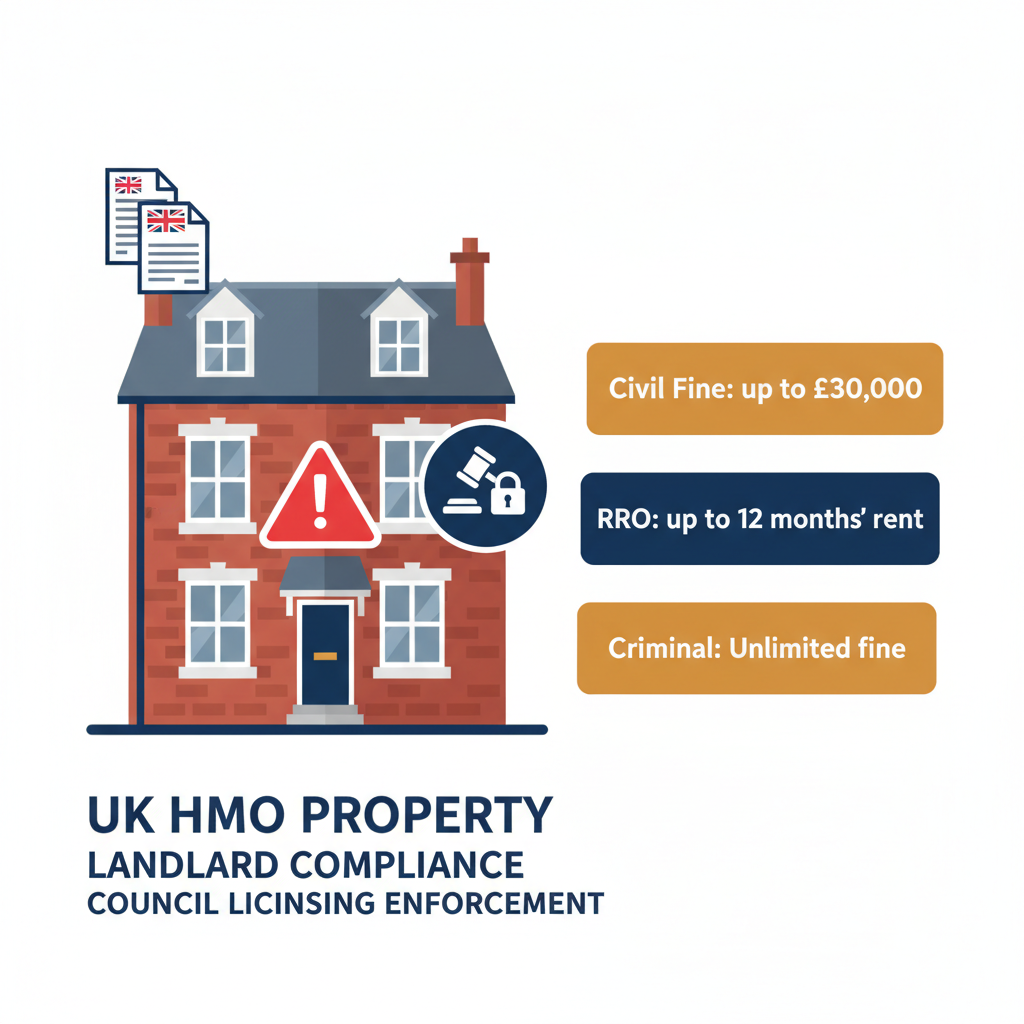
The financial exposure from unlicensed HMO penalties: civil fines, RROs and criminal prosecution runs across three distinct channels, and councils can pursue more than one simultaneously.
The civil financial penalty route, introduced under the Housing and Planning Act 2016 and operational from April 2017, allows councils to impose up to £30,000 per offence without a criminal conviction. Many councils publish their own penalty schedules — Newham Borough Council, for example, has historically issued penalties exceeding £10,000 for individual landlords in a single enforcement action, while councils such as Birmingham have published base penalties of £5,000 rising to £30,000 for aggravated cases involving deliberate non-compliance or poor property conditions.
Separately, a Rent Repayment Order (RRO) allows tenants or the council to apply to the First-tier Tribunal for repayment of up to 12 months' rent. On a property with four tenants each paying £600 per month, that represents a maximum exposure of £28,800 — on top of any civil penalty. RROs have been available since 2004 for housing benefit cases, but the Housing and Planning Act 2016 extended them to all tenants from April 2017 onward, dramatically widening landlord exposure.
Criminal prosecution through the magistrates' court carries an unlimited fine under changes introduced by the Legal Aid, Sentencing and Punishment of Offenders Act 2012. Prior to that change, the maximum criminal fine was capped at £20,000. Conviction also results in a banning order consideration under the Housing and Planning Act 2016, which can prohibit a landlord from letting any property in England for a minimum period of 1 year, with serious cases attracting indefinite bans.
What does a licence application require?
Applications are made to the local housing authority for the area where the property sits. Most councils require the application before the property is occupied by the licensable number of people — not after. A typical five-year HMO licence costs between £500 and £1,500 depending on the council, with some authorities such as Manchester charging fees structured in two parts: an initial non-refundable processing fee followed by a grant fee on approval.
Applications must demonstrate that the proposed licence holder is a fit and proper person, that the property meets the HMO Management Regulations 2006 standards (including room sizes — the nationally prescribed minimum for a single adult sleeping room is 6.51 square metres), and that adequate fire safety measures are in place, including interlinked smoke alarms and, in properties of three or more storeys, emergency lighting in common areas.
What documents do you need?
Most councils require: a valid gas safety certificate (renewed annually), an Electrical Installation Condition Report (EICR) valid for no more than 5 years, Energy Performance Certificate, proof of ownership, planning permission evidence where the property requires a change of use, and fire risk assessment documentation. Some authorities additionally require portable appliance testing records and legionella risk assessment evidence. Processing times vary between 8 and 16 weeks depending on the council and application quality.
What happens if you do not have a licence?
Councils have used civil penalties aggressively since 2017. In 2022–23, Newham Council alone collected over £1 million in housing enforcement penalties, with unlicensed HMOs forming the majority of cases. The Tribunal service reported a 34% increase in RRO applications between 2021 and 2023, reflecting growing tenant awareness of the remedy.
Beyond financial penalties, an unlicensed landlord loses the right to serve a valid Section 21 notice for the duration of the unlicensed period — meaning possession cannot be recovered on a no-fault basis until a licence is granted and any penalty settled. This creates an operational trap: the longer a landlord delays, the longer they may be unable to regain their property.
What this means for your portfolio
The combined exposure from unlicensed HMO penalties: civil fines, RROs and criminal prosecution can exceed £58,000 per property in a worst-case scenario — a £30,000 civil penalty alongside a £28,800 RRO — before legal costs are counted. With over 80 additional licensing schemes operating across England as of 2024, and councils under increasing pressure from central government to enforce more vigorously, the risk of remaining unlicensed has never been higher. Check your local authority's licensing register, apply before you let, and treat the licence fee — typically under £1,500 — as the cost of avoiding a five-figure enforcement action.