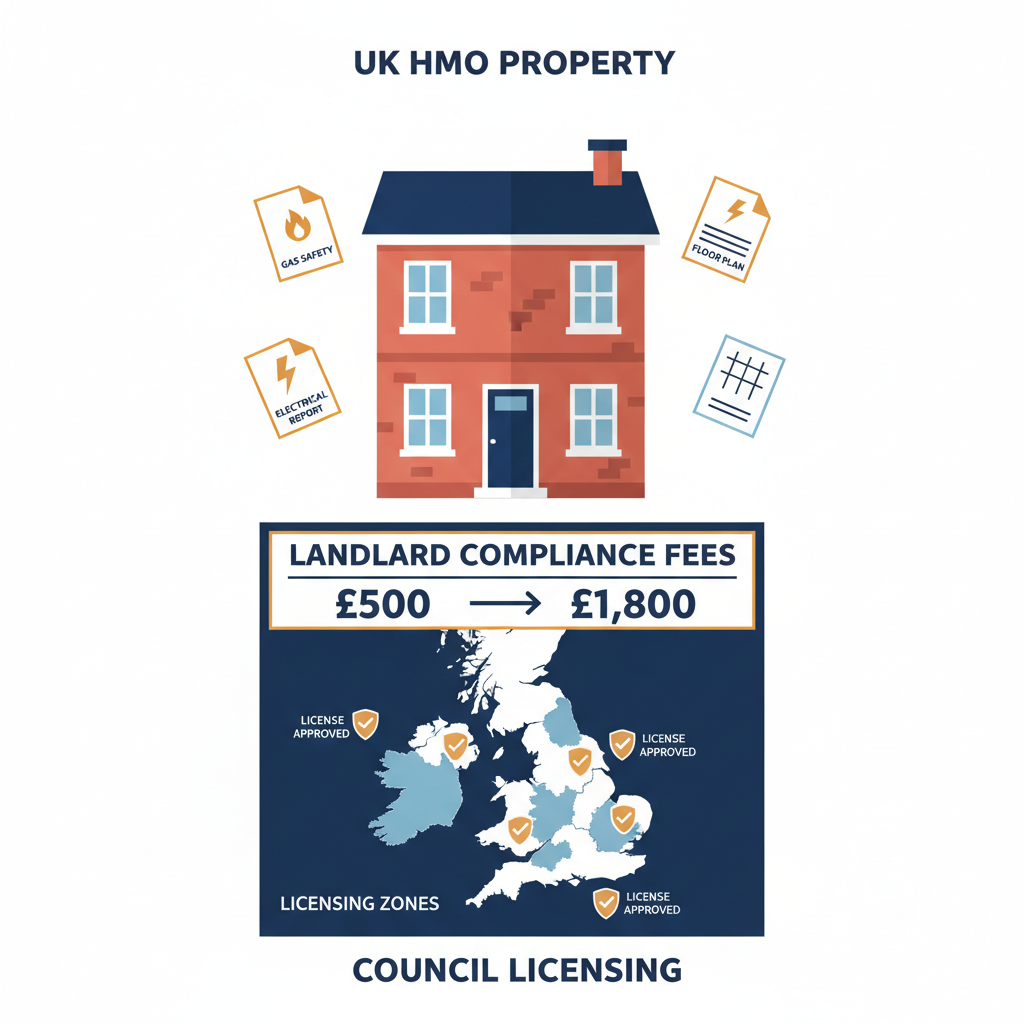
Fees from £500 to £1,800 per 5 years. Additional HMO licensing explained: which councils operate schemes and what landlords must do now.
Additional HMO Licensing Explained: Which Councils Operate Schemes and Why Every Landlord Must Check Their Local Authority Now
If you own a property let to 3 or more people forming 2 or more separate households, there is a greater than 50% chance your local council has introduced additional HMO licensing that captures your property — even if it falls below the mandatory national threshold of 5 occupants. That single statistic is the most important thing to understand before reading anything else on this page.
What Triggers the Additional Licensing Requirement?
Mandatory HMO licensing, which is set nationally, applies to properties occupied by 5 or more people from 2 or more households sharing facilities. Additional licensing is entirely different. Under Section 56 of the Housing Act 2004, individual councils can designate their own schemes covering smaller HMOs — typically those with just 3 or 4 occupants — or extending coverage to specific property types such as converted flats or bedsits that mandatory licensing does not reach.
A council must satisfy the Secretary of State that making a designation is consistent with its housing strategy and that consultation has been carried out for a minimum of 10 weeks before a scheme can go live. Once confirmed, a scheme typically runs for 5 years, after which the council must reassess and re-designate if it wishes to continue. This 5-year cycle is why additional HMO licensing explained: which councils operate schemes is such a frequently searched phrase — schemes expire, new ones launch, and the picture changes every year across England and Wales.
The trigger for needing a licence under an additional scheme is straightforward: if your property sits within the designated area and meets the occupancy definition set by that specific council, you need a licence. There is no minimum floor area or storey requirement in additional licensing the way there is in mandatory; the council sets its own occupancy threshold, commonly 3 or more persons.
What Does an Additional HMO Licence Cost?
Fees vary significantly between local authorities because councils set their own charges to recover administration costs. Across England, the current range runs from approximately £500 at the lower end to over £1,800 for a 5-year licence in high-demand urban boroughs. London councils tend to sit at the top of that range: Newham charges around £1,300 for a 5-year additional licence, while Brent's fee sits closer to £1,150. Outside London, Bristol has set its fee at approximately £860 for 5 years, and Nottingham charges roughly £780.
Many councils split the fee into two stages: a non-refundable application processing fee paid upfront — often around 40% of the total — and a second payment due on grant of the licence. This structure means that even if your application is refused, you will not recover the initial processing element. Some authorities, including several in the North West, offer a 10% to 15% discount to landlords who hold accreditation through schemes such as the National Residential Landlords Association or a local landlord accreditation programme, so it is worth checking eligibility before you apply.
How Do You Actually Apply?
The majority of councils now operate fully digital application portals, though around 20% still require paper submissions or hybrid processes as of 2024. The application process typically takes between 6 and 16 weeks from submission to licence grant, depending on the authority's caseload and whether an inspection is required before determination.
You will need to submit the application in the name of the proposed licence holder, who must be the most appropriate person — usually the owner or a managing agent — and separately identify a fit and proper person. If the licence holder and the manager are different individuals, both must pass a fit and proper person assessment, which includes checks against any convictions for housing offences, fraud, or violence within the preceding 5 years.
What Documents Do You Need?
A standard additional HMO licence application requires a current gas safety certificate (valid within 12 months), an electrical installation condition report (EICR) dated within 5 years, energy performance certificate (EPC), fire alarm commissioning certificate, and an up-to-date floor plan drawn to scale showing room dimensions and uses. Some councils also require evidence of planning permission where a material change of use has occurred, and proof of buildings insurance. Missing even 1 document from this list will typically suspend processing until it is supplied, adding weeks to your timeline.
What Happens If You Don't Have a Licence?
This is where the stakes become very clear. Under Section 72 of the Housing Act 2004, operating a licensable HMO without a licence is a criminal offence carrying an unlimited fine in the magistrates' court. Since the Housing and Planning Act 2016 introduced civil penalty powers, councils can alternatively issue a Civil Penalty Notice of up to £30,000 per offence without needing to prosecute — and several London boroughs now routinely use this power, with Newham alone having issued penalties totalling over £2 million to non-compliant landlords since 2017.
Beyond the direct penalty, an unlicensed landlord faces a Rent Repayment Order application from tenants or the council covering up to 12 months of rent already paid. On a property generating £1,500 per month, that is an £18,000 exposure on top of any fine. A conviction or civil penalty for HMO licensing failure also counts against a landlord's fit and proper person status, which can affect licence applications across multiple properties.
Additional HMO Licensing Explained: Which Councils Operate Schemes — What This Means for Your Portfolio
Checking whether your council operates an additional licensing scheme is not a one-time task. With 5-year designation cycles, approximately 30 to 40 new or renewed schemes launching across England in any given year, a property that was compliant 18 months ago may now fall inside a new designation boundary. The Government's MHCLG maintains a register of approved schemes, and most councils publish their current designation maps on their planning or housing enforcement pages. Cross-referencing your portfolio against that register every 12 months, and whenever you acquire a new property, is the baseline standard of compliance — not a best practice, a minimum.