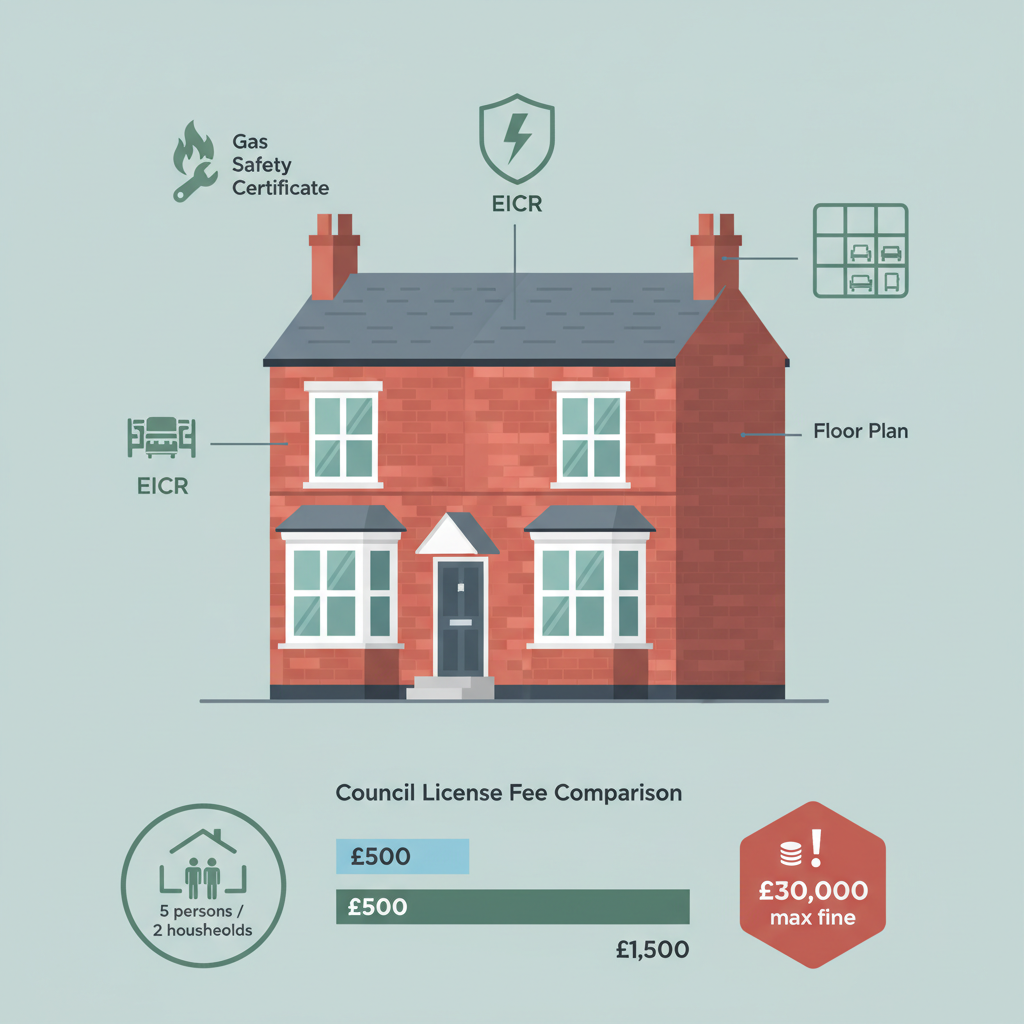
Licence fee from £500–£1,500 for 5 years. Do I Need an HMO Licence: The UK Decision Guide answers every threshold, cost and deadline.
Do I Need an HMO Licence: The UK Decision Guide
If your property is occupied by 5 or more people forming 2 or more separate households and they share facilities such as a kitchen or bathroom, you almost certainly need a mandatory HMO licence under the Housing Act 2004. That single threshold — 5 persons, 2 households — is the starting point every UK private landlord must understand before renting out a shared property.
What Triggers an HMO Licensing Requirement?
The mandatory national licensing scheme applies to any property in England or Wales occupied by 5 or more people in 2 or more households who share a toilet, bathroom or kitchen. This was extended from the previous 3-storey rule on 1 October 2018, meaning thousands of flats and bungalows that were previously exempt were brought into scope overnight. Scotland operates its own system under the Civic Government (Scotland) Act 1982, where all HMOs of 3 or more unrelated persons require a licence regardless of the number of storeys.
Beyond the mandatory national scheme, more than 70 local authorities in England operate Additional and Selective Licensing schemes that lower the occupancy threshold to as few as 3 persons. These discretionary schemes are designated under Part 3 of the Housing Act 2004, typically run for 5 years, and require you to check your specific council's current designations — some have renewed schemes that began as recently as January 2024. If your property sits in a designated area, you need a separate licence even if it falls below the 5-person national threshold.
What Does an HMO Licence Cost?
Licence fees are set locally and vary significantly. A standard 5-year mandatory HMO licence typically costs between £500 and £1,500 depending on the council and the number of occupants. London councils tend to charge at the higher end: Newham's selective licensing fee is £750 per property for 5 years, while Haringey charges £1,287 for a mandatory HMO licence. Outside London, Birmingham charges £655 for a standard 5-year mandatory licence, and Manchester's fee sits at £725. Some councils charge per bedroom rather than per property — Leeds, for instance, charges approximately £160 per lettable room for new applications, meaning a 6-bedroom HMO costs around £960 upfront.
Many councils offer accreditation discounts of between 10% and 20% if you are a member of an approved landlord scheme such as the National Residential Landlords Association (NRLA) or a council-run accreditation programme. A 15% discount on a £1,200 licence saves £180 — worth claiming every renewal cycle.
How Do You Apply for an HMO Licence?
Applications are submitted directly to your local housing authority, most of which now offer online portals. You will need to complete a detailed form covering property layout, the number of rooms and their floor areas, the proposed maximum number of occupants, and details of the licence holder and any managing agents. Room sizes matter: under the Licensing of Houses in Multiple Occupation (Mandatory Conditions) (England) Regulations 2018, any room used as sleeping accommodation for a person aged 10 or over must be at least 6.51 square metres. Rooms below this threshold cannot be let, and councils will condition your licence accordingly.
Most councils process applications within 8 to 12 weeks, though complex cases or incomplete submissions can extend this to 16 weeks or longer. You may operate legally under a pending application as long as you applied before your existing licence expired or, if it is a first application, before any enforcement notice is served.
What Documents Do You Need?
A complete application requires a current gas safety certificate (renewed annually), an Electrical Installation Condition Report (EICR) valid for no more than 5 years, Energy Performance Certificate (EPC) rated at a minimum of E, fire safety risk assessment, proof of ownership or a copy of the head lease, and a floor plan drawn to scale. If you use a managing agent, a signed copy of the management agreement is also required. Missing a single document will delay processing and may result in a rejection requiring a full re-application fee.
What Are the Penalties for Operating Without a Licence?
This is where the consequences become serious. Under Section 72 of the Housing Act 2004, operating an HMO without a licence is a criminal offence carrying an unlimited fine on conviction in a magistrates' court. Since the introduction of Civil Penalty Notices in 2017, councils can alternatively issue fines of up to £30,000 per offence without going to court — and each unlicensed property is a separate offence.
Tenants and former tenants have a further weapon: the Rent Repayment Order (RRO). Under the Housing and Planning Act 2016, tenants can apply to the First-tier Tribunal for repayment of up to 12 months' rent if you were operating without a licence. For a 5-bedroom HMO in Birmingham let at £500 per room per month, that is a potential liability of £30,000 payable directly to your tenants — in addition to any council fine. Courts have awarded RROs totalling over £1 million to tenants nationally in 2023 alone.
Do I Need an HMO Licence: The UK Decision Guide — What This Means in Practice
The compliance picture is straightforward once you map it. Apply the national 5-person threshold first, then check your council's Additional and Selective Licensing designations, then check room sizes against the 6.51 square metre minimum. Licence fees are a known, manageable cost — typically £500 to £1,500 every 5 years. The cost of non-compliance is neither known nor manageable: unlimited criminal fines, civil penalties up to £30,000 and Rent Repayment Orders of up to 12 months' rent combine to make unlicensed operation one of the highest-risk decisions a private landlord can make. Check your council's website today, confirm whether your property is in a designated area, gather your 6 core documents and submit your application before serving any new tenancy agreement.