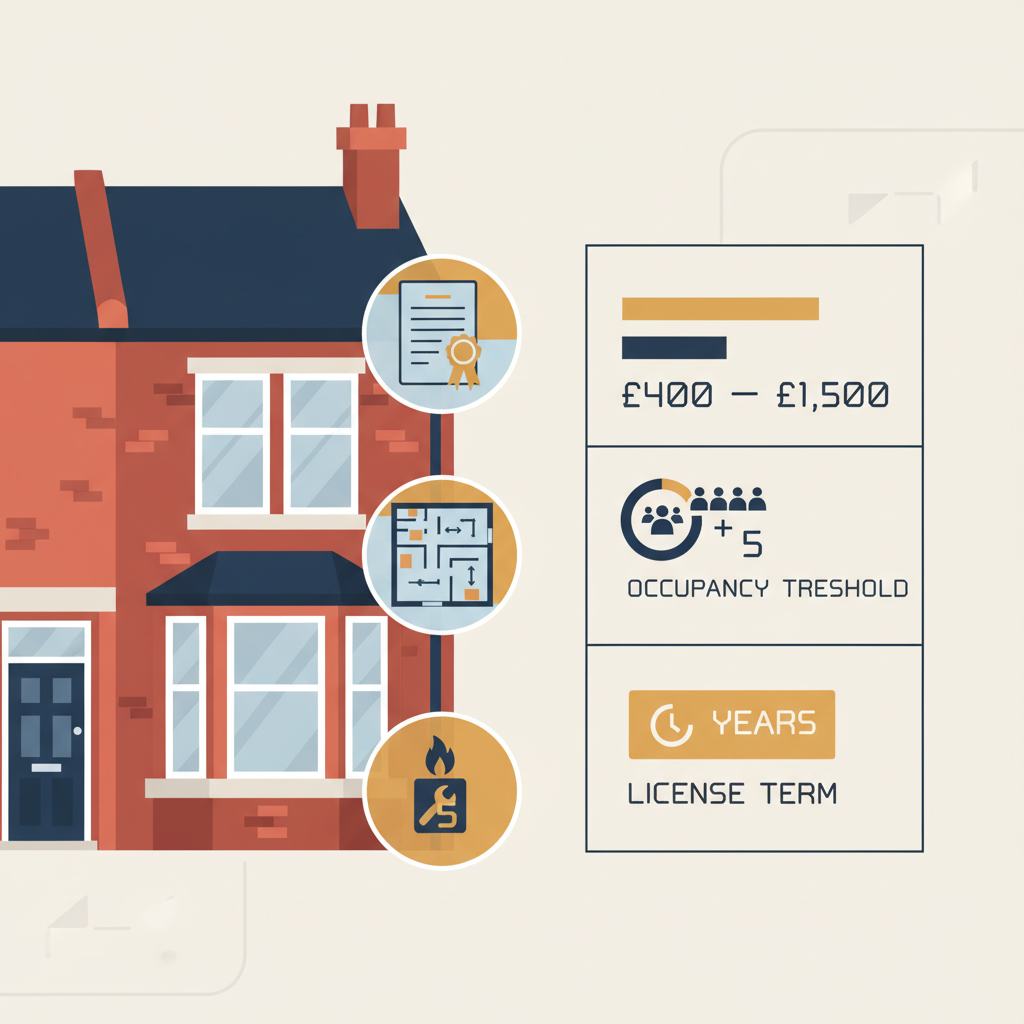
5+ tenants, 3+ storeys: mandatory HMO licence required. Fees from £400–£1,500. Mandatory HMO Licensing Explained: Thresholds, Fees and Compliance. 155 chars.
Mandatory HMO Licensing Explained: Thresholds, Fees and Compliance
If you rent a property to 5 or more people forming 2 or more separate households, you are legally required to hold a mandatory HMO licence under the Housing Act 2004. This is the single most critical threshold every private landlord must know before letting a shared house, and getting it wrong exposes you to civil penalties of up to £30,000 per offence.
What triggers the mandatory HMO licensing requirement?
The mandatory HMO licensing regime applies nationally across England and Wales under regulations that were substantially extended on 1 October 2018. Before that date, only properties of 3 or more storeys were caught by mandatory licensing. The 2018 amendment removed the storey requirement entirely, meaning a standard 2-storey terraced house let to 5 or more occupants now requires a licence in exactly the same way as a larger building. Scotland and Northern Ireland operate separate regimes, with Scotland requiring registration for all HMOs regardless of size under the Civic Government (Scotland) Act 1982.
A household is defined as a family unit, a single person, or a couple. So a 5-bedroom house let to 5 unrelated individuals triggers the requirement immediately. Properties with 4 or fewer occupants, or where all occupants form a single household, fall outside mandatory licensing — though they may still be caught by additional or selective licensing schemes operated locally by up to 70 councils across England.
What does a mandatory HMO licence cost?
Fees are set by individual local authorities and vary considerably across England. Most councils charge between £400 and £1,500 for a 5-year licence, making the annual equivalent roughly £80 to £300. Some councils split fees into a non-refundable application component and a grant component paid only when the licence is issued; Birmingham City Council, for example, charges a non-refundable £263 processing element regardless of outcome. Leeds City Council charges £978 for a standard 5-year mandatory licence. Liverpool City Council's fee sits at £750 for the same term. Landlords who hold accreditation through a recognised scheme such as the National Residential Landlords Association (NRLA) can qualify for discounts of between 10% and 20% at participating authorities.
You should also budget for any required works. Properties must meet minimum room size standards of 6.51 square metres for a single adult and 10.22 square metres for 2 adults sharing, rules that came into force on 1 October 2018 alongside the extended threshold. Rooms below these sizes cannot be used as sleeping accommodation, and failure to comply can trigger a licence condition breach with a financial penalty of up to £5,000.
How do you apply for an HMO licence?
Applications are submitted directly to the local housing authority in whose area the property sits. The majority of councils now offer online portals, though some still require paper applications. You must apply before the property becomes an HMO — operating for even a single day without a licence is an offence. Licences last for a maximum of 5 years and must be renewed before expiry; there is no automatic rollover. Most councils process straightforward applications within 8 to 12 weeks, though complex cases or those requiring inspection can take longer.
What documents do you need to apply?
A standard mandatory HMO licence application requires a gas safety certificate dated within the last 12 months, an electrical installation condition report (EICR) dated within the last 5 years, fire detection and emergency lighting documentation, an energy performance certificate (EPC) at band E or above (rising to band C by 2028 under proposed regulations), and a floor plan showing room dimensions. You will also need to provide details of any managing agent if one is instructed, and confirm that all persons involved in management are fit and proper persons under section 66 of the Housing Act 2004. A criminal record check may be required by some councils. The fit and proper person test considers offences including fraud, dishonesty, violence, drugs, and contraventions of housing law in the preceding 5 years.
What are the penalties for operating without a licence?
Non-compliance carries serious financial consequences. Councils can issue a civil penalty notice of up to £30,000 per offence without going to court, and prosecutions in the magistrates' court can result in an unlimited fine. A landlord convicted of operating an unlicensed HMO also becomes subject to a Rent Repayment Order (RRO) under the Housing and Planning Act 2016, meaning tenants — or the local authority — can apply to the First-tier Tribunal to recover up to 12 months' rent. In 2023, the average successful RRO award in England was approximately £4,200 per tenant, meaning a 5-tenant house could face repayment demands of over £21,000 on top of any penalty. Operating with a licence that has lapsed carries the same liability as never having held one.
What does this mean for landlords managing shared houses?
Mandatory HMO Licensing Explained: Thresholds, Fees and Compliance is not an abstract compliance exercise — it is the legal framework within which approximately 497,000 licensed HMOs currently operate in England according to government figures for 2022–23, a number that rises every year. If your property meets the 5-person, 2-household threshold, licence applications must be submitted proactively; councils are under no obligation to notify you. Check whether your local authority also operates an additional or selective licensing scheme covering smaller shared properties, as around 70 English councils do. Keep your licence displayed in the property and ensure all conditions — covering management standards, refuse facilities, fire precautions, and room sizes — are met throughout the licence term. A condition breach can trigger a financial penalty of up to £5,000 and jeopardise renewal.